
The top of a ladder 6 metre long is resting against a vertical wall on a level pavement, when the ladder begins to slide outwards. At the moment when the foot of the ladder is 4 metres from the wall, it is sliding away from the wall at the rate of 0.5 m/sec. How fast is the top - sliding downwards at this instance?
Given: the top of a ladder 6 metre long is resting against a vertical wall on a level pavement, when the ladder begins to slide outwards, at the moment when the foot of the ladder is 4 metres from the wall, it is sliding away from the wall at the rate of 0.5 m/sec
To find how fast is the top - sliding downwards at this instance
Let AC be the position of the ladder initially, then AC = 6m.
DE be the position of the ladder after being pulled at the rate of 0.5m/sec, then DE = 6m as shown in the below figure.
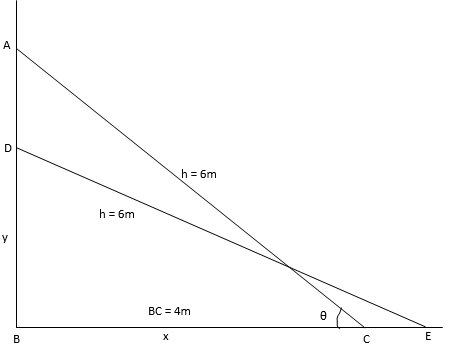
So it is given that foot of the ladder is pulled along the ground away from the wall, at the rate of 0.5m/sec
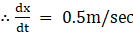 ……………(i)
Consider ΔABC, it is right angled triangle, so by applying the Pythagoras theorem, we get
AB2 + BC2 = AC2
⇒ y2 + x2 = h2……….(ii)
⇒ y2 + (4)2 = (6)2
⇒ y2 = 36 - 16 = 20
⇒ y = 4.47
And in same triangle,

Now differentiate equation(ii) with respect to time, we get


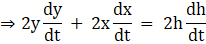
Now substituting the values of x, y, h and  (from equation(i)), we get

The value of h is always constant as the ladder is not increasing or decreasing in size, hence the above equation becomes,


And considering the same triangle,
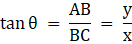
Differentiating the above equation with respect to time we get
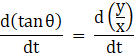
 [applying quotient rule
 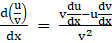 ]
]
Substituting the values of  (from equation(iii)), x, y,
  (from equation(iv) and
  (from equation(i)) the above equation becomes,


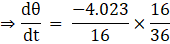

Hence the angle θ between the ladder and the ground is changing at the rate of - 0.11 rad/sec when the foot of the ladder is 4 m away from the wall.
Couldn't generate an explanation.
Generated by AI. May contain inaccuracies — always verify with your textbook.