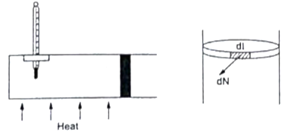
Figure shows a large closed cylindrical tank containing water. Initially the air trapped above the water surface has a height h0 and pressure 2p0 where p0 is the atmospheric pressure. There is a hole in the wall of the tank at a depth h1 below the top from which water comes out. A long vertical tube is connected as shown.
(a) Find the height h2 of the water in the long tube above the top initially.
(b) Find the speed with which water comes out of the hole.
(c) Find the height of the water in the long tube above the top when the water stops coming out of the hole.

Given
Initial height of air trapped =ho
Initial pressure=2Po
Po=atmospheric pressure = 105Pa
Depth at which there is hole in tank =h1
Let the density of water be 
From the diagram we can see that,
Pressure of water above the water level of the bigger tank is given by
P=(h2+ho) g
g
Let the atmospheric pressure above the tube be Po.
Total pressure above the tube=Po+P=(h2+ho) g+Po
g+Po
This pressure initially is balanced by pressure above the tank 2Po (from diagram).
Therefore,
2Po=(h2+ho) g+Po
g+Po
Po=(h2-h0) g
g

 The height h2 of the water in the long tube above the top initially is given by
(b)
Efflux means water flowing out from tube or outlet.
Velocity of efflux out of the outlet depends upon the total pressure above the outlet.
Total pressure above the outlet=2Po+(h1-ho) g
g
Let the velocity of efflux be v1 and the velocity with which the level of tank falls be v2.
Pressure outside the outlet =Po
Bernoulli's principle states that an increase in the speed of a fluid occurs simultaneously with a decrease in pressure or a decrease in the fluid's potential energy.
Mathematically Bernoulli’s theorem can be written as
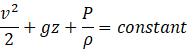
Where v=velocity of fluid at a point
z= elevation of that point from a reference level
P=pressure of fluid at that point
 =density of that fluid
G=acceleration due to gravity
Applying Bernoulli’s theorem, at points outside the outlet and above the outlet, we get

Consider the difference in elevation of both the points very small, so that we can ignore ‘gz’ term on both the sides.
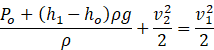
Again, the speed with which the water level of the tank goes out is very less compared to the velocity of the efflux. Thus, v2=0


 The speed with which water comes out of the hole is given by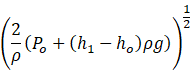
(c) Water maintains its own level, so height of the water of the tank will be h1 when water will stop flowing out.
Thus, height of water in the tube below the tank height will be =h1
Hence height if the water above the tank will be =-h1
Couldn't generate an explanation.
Generated by AI. May contain inaccuracies — always verify with your textbook.