
A capacitor having a capacitance of 100 μF is charged to a potential difference of 24V. The charging battery is disconnected and the capacitor is connected to another battery of emf 12V with the positive plate of the capacitor joined with the positive terminal of the battery.
a) Find the charges on the capacitor before and after the reconnection.
b) Find the charge flown through the 12V battery.
c) Is work done by the battery or is it done on the battery? Find its magnitude.
d) Find the decrease in electrostatic field energy.
e) Find the heat developed during the flow of charge after reconnection.
Given
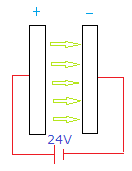
Capacitance =100 μF
Initial battery voltage used = 24V
Second voltage used = 12V
a) Charges on the capacitor before and after the reconnection.
Before reconnection, the battery used is 24V, hence


We know charge present on a capacitor is given by
q = CV 1)
Where q = charge
C=capacitance
V=voltage
Substituting in 1)

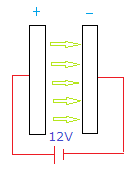


Similarly, after connection of 12V battery –
When C = 100μf
V = 12V
Using equation 1)



b) Charge flown through the 12V battery.
C = 100, V = 12V
From 1),

Substituting the values,


c) Work is done by the battery, and its magnitude is as follows
We know

Where V = applied voltage across the capacitor
W = work done and
q = charge on the surface of the parallel plate capacitor
Which gives,



 is the amount of work done on the battery.
d) Decrease in electrostatic field energy
Electrostatic field energy stored is given by –
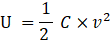
 , c = capacitance
v= voltage across capacitor
Initially, electrostatic field energy stored is given by -
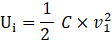
Final Electrostatic field energy

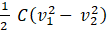
Decrease in Electrostatic field energy
= 
= 
= 
Substituting the values
Capacitance =100 μF
Initial battery voltage used = 24V
Second voltage used = 12V
=

e) Heat developed during the flow of charge after reconnection
After reconnection
C = 100μc, V = 12v
We know the energy stored, E in capacitor is given by

Where c is the capacitance and v is the applied voltage
Substituting values –
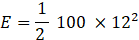

This is the amount of energy developed as heat when the charge flows through the capacitor.
Couldn't generate an explanation.
Generated by AI. May contain inaccuracies — always verify with your textbook.
