Q46 of 94 Page 166

Consider the situation shown in figure. The switch S is open for a long time and then closed.

a) Find the charge flown through the battery when the switch S is closed.


b) Find the work done by the battery.


c) Find the change in energy stored in the capacitors.


d) Find the heat developed in the system.


Given circuit as shown below -
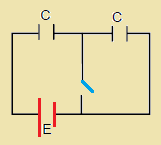


a) Charge flown through the battery when the switch S is closed. Since the switch was open for a long time, hence the charge flown must be due to the both.


When the switch is closed, the capacitor is in series, the equivalent capacitance is given by


Now, we know the relation between capacitance, charge q and voltage v given by ,


b) Work done by the battery


We know, work done is given by


Where q is charge stored and v is the applied voltage


We have, and


Substituting the values, we get,


=


c) Change in energy stored in the capacitors


Energy stored in capacitor is given by –



Initially, the energy stored in the capacitor is given by


1)


After closing the switch, the capacitance changes to


Energy stored after closing the switch is given by -



2)


From 1) and 2)


Change in energy stored in the capacitors


=


= 3)


d) Heat developed in the system


The net change in the stored energy is wasted as heat developed in the system,


Hence, heat developed in the systems is given as-


H=∆E


Where, H is the heat developed and ∆E is the change in the stored energy in the capacitor


From 3)


More from this chapter

All 94 →
44

A parallel-plate capacitor having plate area 20 cm2 and separation between the plates 1.00 mm is connected to a battery of 12.0 V. The plates are pulled apart to increase the separation to 2.0 mm.

a) Calculate the charge flown through the circuit during the process.


b) How much energy is absorbed by the battery during the process?


c) Calculate the stored energy in the electric field before and after the process.


d) Using the expression for the force between the plates, find the work done by the person pulling the plates apart.


e) Show and justify that no heat is produced during this transfer of charge as the separation is increased.


45

A capacitor having a capacitance of 100 μF is charged to a potential difference of 24V. The charging battery is disconnected and the capacitor is connected to another battery of emf 12V with the positive plate of the capacitor joined with the positive terminal of the battery.

a) Find the charges on the capacitor before and after the reconnection.


b) Find the charge flown through the 12V battery.


c) Is work done by the battery or is it done on the battery? Find its magnitude.


d) Find the decrease in electrostatic field energy.


e) Find the heat developed during the flow of charge after reconnection.


47

A capacitor of capacitance 5.00 μF is charged to 24.0V and another capacitor of capacitance 6.0 μF is charged to 12.0V.

a) Find the energy stored in each capacitor.


b) The positive plate of the first capacitor is now connected to the negative plate of the second nd vice versa. Find the new charges on the capacitors.


c) Find the loss of electrostatic energy during the process.


d) Where does this energy go?


48

A 5.0 μF capacitor is charged to 12V. The positive plate of this capacitor is now connected to the negative terminal of a 12V battery and vice versa. Calculate the heat developed in the connecting wires