
Figure shows a typical circuit for low-pass filter. An AC input Vi = 10 mV is applied at the left end and the output V0 is received at the right end. Find the output voltages for v = 10 kHz, 100 k Hz, 1.0 MHz and 10.0 MHz Note that as the frequency is increased the output decreases and hence the name low-pass filter.

Given: Voltage V1=10×10-3V,
Resistance (R) =1×10³ ohm,
Capacitance (C) =10×10-9 F
Angular velocity  will be

{a} At frequency (f) =10kHz
Reactance, 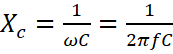

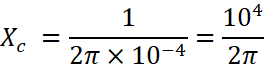
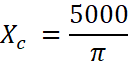
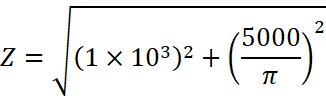
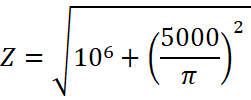
Impedance, 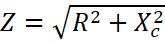
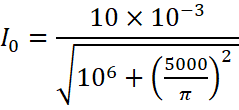
Then, Current (I0) will be

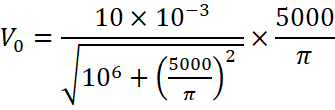
Thus, Output voltage (V0) will be


{b} At frequency (f) =100kHz
Reactance, 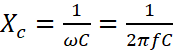
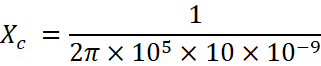
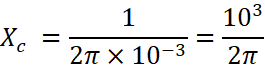
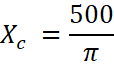
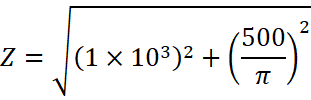
Impedance, 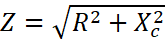

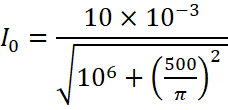
Then, Current (I0) will be

Thus, Output voltage (V0) will be



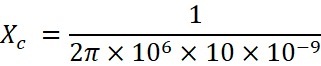
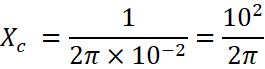
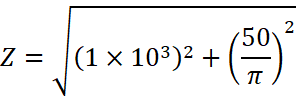
{c} At frequency (f) =1 MHz
Reactance, 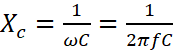

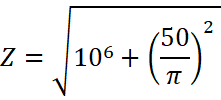
Impedance, 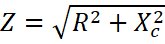
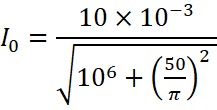
Then, Current (I0) will be

Thus, Output voltage (V0) will be


{a} At frequency (f) =10 MHz
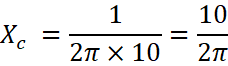
Reactance, 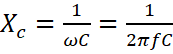


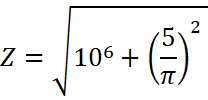
Impedance, 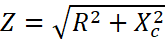

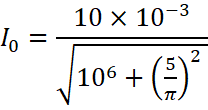
Then, Current (I0) will be

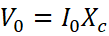
Thus, Output voltage (V0) will be


Couldn't generate an explanation.
Generated by AI. May contain inaccuracies — always verify with your textbook.