
A river is flowing from west to east at a speed of 5 meters per minute. A man on the south bank of the river, capable of swimming at 10 meters per minute in still water, wants to swim across the river in the shortest time. He should swim in a direction
Let us consider the width of the river be  . Let the man swims at some angle
  with velocity
  . This is shown below in the figure
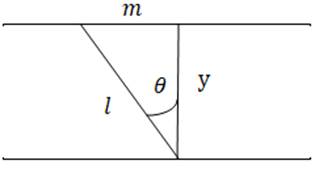
Where,  =distance travelled by man and
  is constant
By Pythagoras theorem in above triangle formed, we have
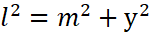
Differentiating above equation with respect to time, we get


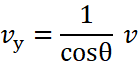
Negative sign is due to decrease in the distance, covered by man, as time goes. Man can also go along  through the river with velocity
  .
.
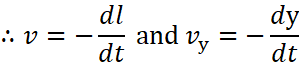
Therefore, the equation (1) becomes
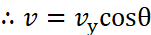
Therefore, time taken by the Man to pass the river with velocity  along the line making angle
  is
is
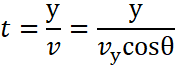
Therefore, the man takes shortest time when  is maximum.
  is maximum when
  . Thus, we say that the man should swim along
  that is towards north so that he crosses the river in shortest possible time.
Couldn't generate an explanation.
Generated by AI. May contain inaccuracies — always verify with your textbook.