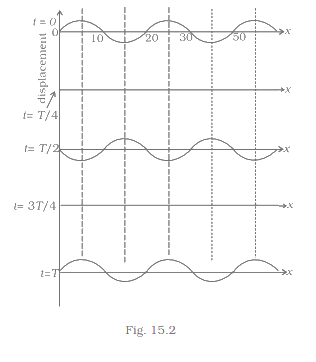
The pattern of standing waves formed on a stretched string at two instants of time are shown in Fig. 15.3. The velocity of two waves superimposing to form stationary waves is 360 ms-1 and their frequencies are 256 Hz.

(a) Calculate the time at which the second curve is plotted.
(b) Mark nodes and antinodes on the curve.
(c) Calculate the distance between A′ and C′.
Given:
Frequency of the wave = 256 Hz
Velocity of the wave = 360ms-1
(a) In the second instant, all the points of the wave are at the mean position. The time taken to reach the mean position from the amplitude is therefore the time at which the second curve is plotted. The distance to reach the mean position from the amplitude is distance between a node and an antinode that equals one-fourth the wavelength. The wavelength therefore is given by,

where v is the velocity and f is the frequency of the wave.

And

Therefore time taken to reach mean position,

Therefore, the second curve was plotted at time of t = 9.72 x 10⁻⁴ s.
(b) Nodes are points that undergo the minimum displacement and antinodes are points that undergo the maximum displacement. Thus, the points A, B, C, D, E, are the node and the points A’ and C’ are the antinodes.
(c) A’ and C’ are successive antinodes, and the distance between two successive antinodes is the wavelength of the wave, therefore

Couldn't generate an explanation.
Generated by AI. May contain inaccuracies — always verify with your textbook.