Q22 of 26 Page 1

Explain briefly the process of charging a parallel plate capacitor when it is connected across a d.c. battery.

A capacitor of capacitance ‘C’ is charged to ‘V’ volts by a battery. After some time, the battery is disconnected and the distance between the plates is doubled. Now a slab of dielectric constant, 1 < k < 2, is introduced to fill the space between the plates. How will the following be affected: (a) The electric field between the plates of the capacitor


(b) The energy stored in the capacitor


Justify your answer by writing the necessary expressions.


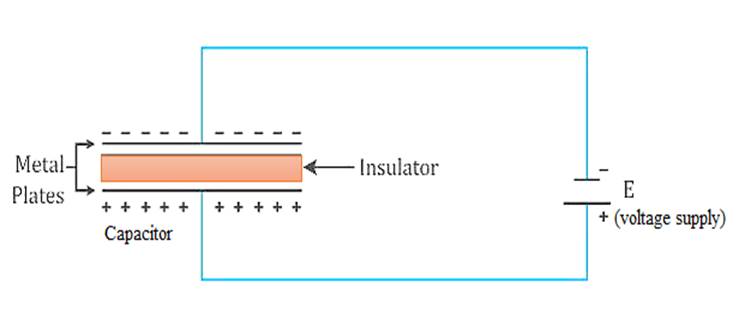
Consider a parallel plate capacitor connected across a d.c. voltage supply as shown in the figure. When the circuit is closed, the electric current will flow through it. As the charges reaches to the plate, the insulating gap does not allow the charges to move further; hence, positive charges get deposited on one side of the plate and negative charges get deposited on the other side of the plate. When the voltage starts to develop, the electric charge begins to resist the deposition of further charge. Thus, the current flowing through the circuit gradually becomes less and then zero till the voltage of the capacitor is exactly equal but opposite to the voltage of the battery. This is how the capacitor gets charged when it is connected across a d.c. battery.


(a) The electric field between the plates is


The distance between plates is doubled, d' = 2d



Therefore, when the distance between the plates is double, the electric field will reduce


to one half.


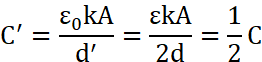
(b) As the capacitance of the capacitor,


Energy stored in the capacitor is


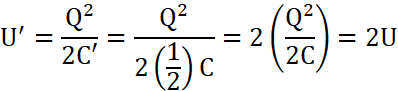
Therefore, when the distance between the plates is doubled, the capacitance reduces to half. Therefore, energy stored in the capacitor becomes double.


More from this chapter

All 26 →
20

An object is placed 15 cm in front of a convex lens of focal length 10 cm. Find the nature and position of the image formed. Where should a concave mirror of radius of curvature 20 cm be placed so that the final image is formed at the position of the object itself?

21

Arrange the following electromagnetic waves in the order of their increasing wavelength:

(a) γ-rays


(b) Microwaves


(c) X-rays


(d) Radio waves


How are infra-red waves produced? What role does infra-red radiation play in (i) maintaining the Earth’s warmth and (ii) physical therapy?


23

Ajit had a high-tension tower erected on his farm land. He kept complaining to the authorities to remove it as it was occupying a large portion of his land. His uncle, who was a teacher, explained to him the need for erecting these towers for efficient transmission of power. As Ajit realized its significance, he stopped complaining. Answer the following questions:

(a) Why is it necessary to transport power at high voltage?


(b) A low power factor implies large power loss. Explain.


(c) Write two values each displayed by Ajit and his uncle.


24

(a) Define self-inductance of a coil. Obtain an expression for the energy stored in a solenoid of self-inductance ‘L’ when the current through it grows from zero to ‘I’.

(B) Derive the expression for the magnetic field due to a solenoid of length ‘2 l’, radius ‘a’ having ‘n’ number of turns per unit length and carrying a steady current ‘I’ at a point on the axial line, distant ‘r’ from the centre of the solenoid. How does this expression compare with the axial magnetic field due to a bar magnet of magnetic moment ‘m’


OR


(a) Draw the magnetic field lines due to a circular loop of area Acarrying current I. Show that it acts as a bar magnet of magnetic momentum AI.


(b) Derive the expression for the magnetic field due to a solenoid of length ‘2 l’, radius ‘a’ having ‘n’ number of turns per unit length and carrying a steady current ‘I’ at a point on the axial line, distant ‘r’ from the centre of the solenoid. How does this expression compare with the axial magnetic field due to a bar magnet of magnetic moment ‘m’ ?