
(a) Define self-inductance of a coil. Obtain an expression for the energy stored in a solenoid of self-inductance ‘L’ when the current through it grows from zero to ‘I’.
(B) Derive the expression for the magnetic field due to a solenoid of length ‘2 l’, radius ‘a’ having ‘n’ number of turns per unit length and carrying a steady current ‘I’ at a point on the axial line, distant ‘r’ from the centre of the solenoid. How does this expression compare with the axial magnetic field due to a bar magnet of magnetic moment ‘m’
OR
(a) Draw the magnetic field lines due to a circular loop of area Acarrying current I. Show that it acts as a bar magnet of magnetic momentum AI.
(b) Derive the expression for the magnetic field due to a solenoid of length ‘2 l’, radius ‘a’ having ‘n’ number of turns per unit length and carrying a steady current ‘I’ at a point on the axial line, distant ‘r’ from the centre of the solenoid. How does this expression compare with the axial magnetic field due to a bar magnet of magnetic moment ‘m’ ?
(a) Self-inductance is defined as induced emf produced per unit rate change of current through the inductance coil i.e.
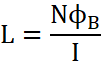
When the current is changing, then the flux associated with the coil changes and an e.m.f. is induced in the coil. It is given by
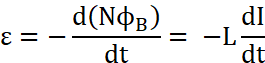
The self-induced e.m.f. is also called back e.m.f. as it opposes any change in current in the circuit. Therefore, work should be done against the back e.m.f. in establishing current. This work done is stored as magnetic potential energy.
The rate of doing work is given as
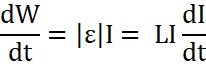
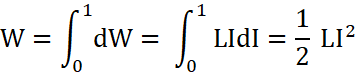
Thus, the total work done in inducing current from 0 to I is
(b) The direction of induced current in the loop as it goes out is depicted in the figure below
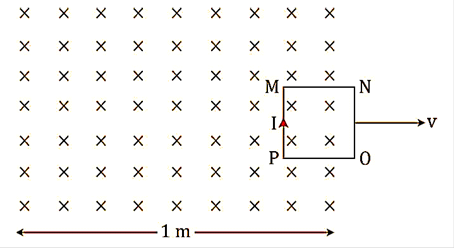
The current will persist till the entire loop comes out of the field. Hence, we have
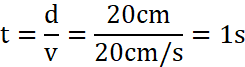
Hence, the current will persist for 1 second.
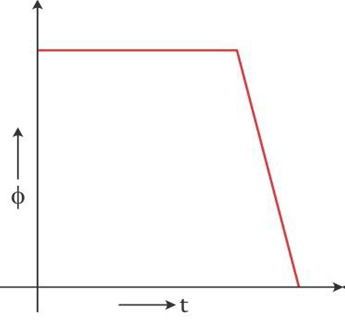
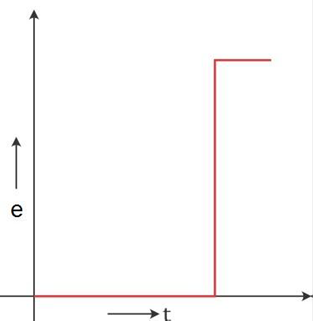
(ii) The magnetic flux in the coil when it is inside the field is constant. The maximum flux is given as ϕ= Bla where a is the side of the square loop. This flux will start decreasing once the loop starts coming out of the field and will be zero when it is completely out of the field. The e.m.f. induced in the coil when it is inside the field is zero because the flux is not changing. When the loop just comes out of the field, the flux change is maximum and the e.m.f. induced is given as

This e.m.f remains constant till the entire loop comes out. When the loop is completely out of the field, the e.m.f. drops to zero again.
OR
(a) When a circular loop carries current I with the area A, the loop develops a magnetic field around itself. The strength of the magnetic field developed depends on the current running through the wire. At the centre of the loop, the magnetic field lines are perpendicular to the plane of the loop which gives the magnetic moment, m = IA. Hence, it behaves like a magnet.
When we compare the magnetic field lines around a current-carrying loop and a bar magnet, it shows that both the patterns are similar. If the current in the loop is in the anticlockwise direction, a North Pole is formed and if the current is in the clockwise direction, a South Pole is formed
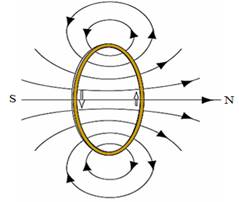
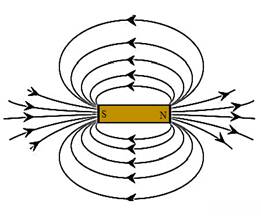
(b) Consider a solenoid of length 2l, radius a and having n turns per unit length. It is carrying a current I. We have to evaluate the axial field at a point P at a distance r from the centre of the solenoid.
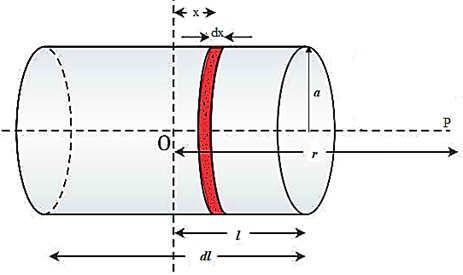
Let us consider the small element of thickness dx of the solenoid as shown in the figure. Let it be x distance away from its centre O. the magnetic field due to the small circular loop carrying current I is given as
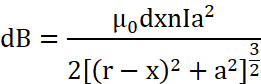
Integrating both the sides
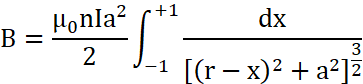
For r>>a and r>>1, the  , hence,

The magnitude of the magnetic moment is given as the product of total number of turns of wire, current lowing in the wire and cross section area of the solenoid. Therefore,

Therefore, the magnetic field is given as
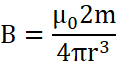
This is the magnetic field due to a solenoid on the axial line at a distance r from the centre.
Couldn't generate an explanation.
Generated by AI. May contain inaccuracies — always verify with your textbook.