
Find the values of k for which the given quadratic equation has real and distinct roots:
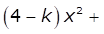
(i) 
(ii) 
(iii) 
For a quadratic equation, ax2 + bx + c = 0,
D = b2 – 4ac
If D > 0, roots are real and distinct

⇒ D = 4 – 4k
⇒ 4 – 4k > 0
⇒ k < 1
(ii) 
For a quadratic equation, ax2 + bx + c = 0,
D = b2 – 4ac
If D > 0, roots are real and distinct

⇒ D = 36 – 4k
⇒ 36 – 4k > 0
⇒ k < 9
(iii) 
For a quadratic equation, ax2 + bx + c = 0,
D = b2 – 4ac
If D > 0, roots are real and distinct

⇒ D = k2 – 36
⇒ k2 – 36 > 0
⇒ (k + 6)(k – 6) > 0
⇒ k < -6 or k > 6
AI is thinking…
Couldn't generate an explanation.
Generated by AI. May contain inaccuracies — always verify with your textbook.



 .
.