Skip to content
Philoid
Browse Saved
Back to chapter
Mathematics
10. Area
Home · Class 9 · Mathematics · Ref. Book · 10. Area
Prev
Next
Q7 of 83 Page 351

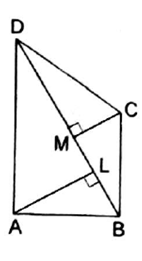
BD is one of the diagonals of a quad. ABCD. If AL ⊥ BD and CM ⊥ BD, show that ar(quad. ABCD) = x BD x (AL + CM).

Given :


AL ⊥ BD and CM ⊥ BD


To prove : ar (quad. ABCD) = x BD x (AL + CM)


Proof:


Area of ABD = x BD x AM


Area of ABD = x BD x CM


Now area of Quad ABCD = Area of ABD + Area of BCD


= x BD x AL + x BD x CM


= x BD x (AL + CM)


Hence proved


More from this chapter

All 83 →
5

Calculate the area of trap. PQRS, given in Fig. (ii).

6

In the adjoining figure, ABCD is a trapezium in which AB ‖ DC; AB = 7 cm; AD = BC = 5 cm and the distance between AB and DC is 4 cm. Find the length of DC and hence, find the area of trap. ABCD.

8

In the adjoining figure, ABCD is a quadrilateral in which diag. BD = 14 cm. If AL ⊥ BD and CM ⊥ BD such that AL = 8 cm and CM = 6 cm, find the area of quad. ABCD.

9

In the adjoining figure, ABCD is a trapezium in which AB ‖ DC and its diagonals AC and BD intersect at O. Prove that ar(∆AOD) = ar(∆BOC).

Questions · 83
10. Area
1 2 3 4 5 5 6 7 8 9 10 11 12 13 14 15 16 17 18 19 20 21 22 23 24 25 26 1 2 3 4 5 6 7 8 9 10 11 12 13 14 15 16 17 18 19 20 21 22 23 24 25 26 27 28 29 30 31 32 33 34 1 2 3 4 5 6 7 8 9 10 11 12 13 14 15 16 17 18 19 20 21 22
Back to chapter
ADVERTISEMENT
About Contact Privacy Terms
Philoid · 2026
  • Home
  • Search
  • Browse
  • Quiz
  • Saved