
Fill in the blanks with the correct symbol out of >, = and <:
(i) (ii)
(ii) (iii)
(iii)
(iv) (v)
(v) (vi)
(vi)
(i) Clearly,

(ii)
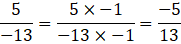
 and
and  have different denominators.
Therefore, we take LCM of 13 and 91 that is 91.
Now,
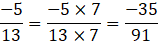
And,
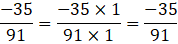
Clearly, 
Hence,

(iii) We can write 
 and
and  have different denominators.
Therefore, we take LCM of 1 and 5 that is 5.
Now,
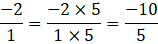
And,

Since, -10 > -13
Therefore, 
Hence, 
(iv)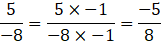
 and
and  have different denominators.
Therefore, we take LCM of 3 and 8 that is 24.
Now,
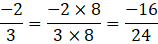
And,

Since, -16 < -15
Therefore, 
Hence, 
(v)

 is a positive number and all positive numbers are greater than 0.
Therefore, 
Hence, 
(vi)  and
and  have different denominators.
Therefore, we take LCM of 9 and 10 that is 90.
Now,
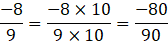
And,

Since, -80 > -81
Therefore, 
Hence, 
Couldn't generate an explanation.
Generated by AI. May contain inaccuracies — always verify with your textbook.
 or 0 (ii)
 or 0 (iii)
 or
or
 or
or (v)
(v) or
or (vi)
(vi) or
or
 or
or (ii)
(ii) or
or (iii)
(iii) or
or
 or
or (v)
(v) or
or (vi)
(vi) or
or
 (ii)
(ii)
 (iv)
(iv)
 (ii)
(ii)
 (iv)
(iv)