
Add the following rational numbers:
(i) and
and (ii)
(ii) and
and (iii)
(iii) and
and
(iv) and
and (v)
(v) and
and (vi)
(vi) and
and
(i) 


(ii) 
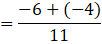


(iii) 


To convert it into lowest terms, divide both numerator and denominator by common divisor of both 6 and 8 that is, 2


(iv) 


To convert it into lowest terms, divide both numerator and denominator by common divisor of both 6 and 3 that is, 3.


=2
(v) 


To convert it into lowest terms, divide both numerator and denominator by common divisor of both 4 and 6 that is, 2.


(vi) 


To convert it into lowest terms, divide both numerator and denominator by common divisor of both 18 and 15 that is, 3.


AI is thinking…
Couldn't generate an explanation.
Generated by AI. May contain inaccuracies — always verify with your textbook.
 (ii)
(ii) (iii)
(iii) (iv)
(iv)
 (vi)
(vi) (vii)
(vii) (viii)
 lies to the left of 0 on the number line.
 lies to the right of 0 on the number line.
 and
and are on opposite sides of 0 on the number line.
 lies to the left of 0 on the number line.
 and
and (ii)
(ii) and
and (iii)
(iii) and
and
 and
and (v)
(v) and
and
 and
and (vii)
(vii) and
and
 and
and (ix)
(ix) and
and
 (ii)
(ii)
 (iv)
(iv)