Q2 of 33 Page 18

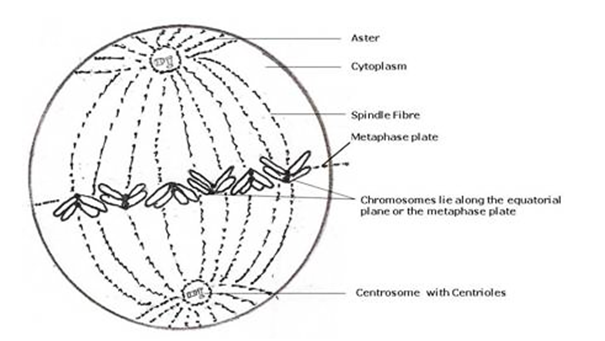
Draw a labelled diagram to show the metaphase stage of mitosis in an animal cell having '6' chromosomes.

The stage described in the diagram is the Metaphase of mitosis in an animal cell having ‘6’ chromosomes. The stage can be identified by the presence of spindle fiber through which chromosomes are line up at the center forming metaphase plate.

More from this chapter

All 33 →
4

Mention whether the following statements are true (T) or false (F). Give reason in support of your answer.

(a) As you grow from childhood to adulthood, your skin cells divide only to replace such cells that are lost from the surface. (T/F)


(b) The unfertilized human egg has half the number of chromosomes of the body cells. (T/F)


(c) The nuclear membrane in a mitotically dividing cell remains intact up to the metaphase and disappears only in the telophase. (T/F)


(d) Mitotic cell division can be a mode of reproduction. (T/F)


(e) Crossing-over between chromatids can occur only between homologous chromosomes. (T/F)

1

The diagram below represents a stage during cell division. Study the same and then answer the questions that follow:


(a) Name the parts labelled 1, 2 and 3.


(b) Identify the above stage and give a reason to support your answer.


(c) Mention where in the body this type of cell division occurs.


(d) Name the stage prior to this stage and draw a diagram to represent the same.

3

The diagram given below represents a certain phenomenon which occurs during meiosis. Name and explain the phenomenon by using the terms - homologous chromosomes, chromatids, crossing-over.

4

Given below is a diagram representing a stage during mitotic cell division in an animal cell.

Examine it carefully and answer the questions which follow.


(a) Identify the stage. Give one reason in support of your answer.


(b) Name the cell organelle that forms the 'aster'.


(c) Name the parts labelled 1, 2 and 3.


(d) Name the stage that follows the one shown here.


How is that stage identified?


(e) Mention two differences between mitosis and meiosis with regard to:


(i) The number of daughter cells produced.


(ii) The chromosome number of the daughter cells.