Skip to content
Philoid
Browse Saved
Back to chapter
Mathematics
8. Quadrilaterals
Home · Class 9 · Mathematics · NCERT Mathematics Exemplar · 8. Quadrilaterals
Prev
Next
Q10 of 56 Page 78

In Fig. 8.7, P is the mid-point of side BC of a parallelogram ABCD such that ∠BAP = ∠DAP. Prove that AD = 2CD.

Since ABCD is a parallelogram, AD||BC and AB is a transversal.

(Sum of co-interior angles is 180)


In ΔABP,


(opposite sides of equal angles are equal)


Now, multiply both sides by 2, we get,


(P is mid-point of BC)


(AB||CD and AD||BC)


Hence, Proved.


More from this chapter

All 56 →
8

D, E and F are the mid-points of the sides BC, CA and AB, respectively of an equilateral triangle ABC. Show that D DEF is also an equilateral triangle.

9

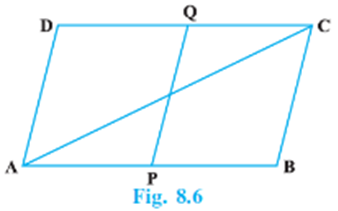
Points P and Q have been taken on opposite sides AB and CD, respectively of a parallelogram ABCD such that AP = CQ (Fig. 8.6). Show that AC and PQ bisect each other.

1

A square is inscribed in an isosceles right triangle so that the square and the triangle have one angle common. Show that the vertex of the square opposite the vertex of the common angle bisects the hypotenuse.

2

In a parallelogram ABCD, AB = 10 cm and AD = 6 cm. The bisector of ∠A meets DC in E. AE and BC produced meet at F. Find the length of CF.

Questions · 56
8. Quadrilaterals
1 2 3 4 5 6 7 8 9 10 11 12 13 14 1 2 3 4 5 6 7 8 9 10 11 12 13 14 1 2 3 4 5 6 7 8 9 10 1 2 3 4 5 6 7 8 9 10 11 12 13 14 15 16 17 18
Back to chapter
ADVERTISEMENT
About Contact Privacy Terms
Philoid · 2026
  • Home
  • Search
  • Browse
  • Quiz
  • Saved