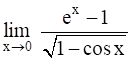
Evaluate the following limits:

As we need to find 
We can directly find the limiting value of a function by putting the value of the variable at which the limiting value is asked if it does not take any indeterminate form (0/0 or ∞/∞ or ∞-∞, .. etc.)
Let Z = 
∴ we need to take steps to remove this form so that we can get a finite value.
TIP: Most of the problems of logarithmic and exponential limits are solved using the formula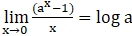 and
and 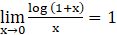
This question is a direct application of limits formula of exponential limits.
As Z = 
⇒ Z = 
⇒ Z = 
{using properties of exponents}
⇒ Z = 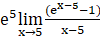
{using algebra of limits}
As, x→ 5
∴ x-5→ 0
Let, y = x-5
∴ if x→5 ⇒ y→0
Hence, Z can be rewritten as-
Z = 
Use the formula: 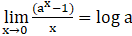
∴ Z = e5 log e
{∵ log e = 1}
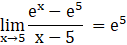
Hence,
Couldn't generate an explanation.
Generated by AI. May contain inaccuracies — always verify with your textbook.