
One bag contains 4 yellow and 5 red balls. Another bag contains 6 yellow and 3 red balls. A ball is transferred from the first bag to the second bag, and then a ball is drawn from the second bag. Find the probability that ball drawn is yellow.
Given:
The bag I contains 4 yellow and 5 red balls.
Bag II contains 6 yellow and 3 red balls.
A ball is transferred from bag I to bag II and then a ball is drawn from bag II.
There are two mutually exclusive ways to draw a yellow ball from bag II –
a. A yellow ball is transferred from the bag I to bag II, and then, a yellow ball is drawn from bag II
b. A red ball is transferred from the bag I to bag II, and then, a yellow ball is drawn from bag II
Let E1 be the event that yellow ball is drawn from the bag I and E2 be the event that red ball is drawn from the bag I.
Now, we have

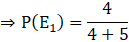

We also have



Let E3 denote the event that yellow ball is drawn from bag II.
Hence, we have

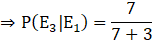

We also have

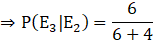

Using the theorem of total probability, we get
P(E3) = P(E1)P(E3|E1) + P(E2)P(E3|E2)

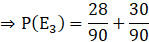
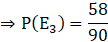

Thus, the probability of the drawn ball being yellow is .
.
Couldn't generate an explanation.
Generated by AI. May contain inaccuracies — always verify with your textbook.
