Q29 of 30 Page 13

A factory has two machines A and B. Past records show that the machine A produced 60% of the items of output and machine B produce 40% of the items. Further 2% of the items produced by machine A were defective and 1% produced by machine B were defective. If an item is drawn at random, what is the probability that it is defective?

Given:


Machine A produced 60% of the total items.


Machine B produced 40% of the total items.


2% of the items produced by machine A were defective.


1% of the items produced by machine B were defective.


There are two mutually exclusive ways to draw a defective item produced by one of the two machines –


a. Item was produced by machine A, and then, the item is defective


b. Item was produced by machine B, and then, the item is defective


Let E1 be the event that the item was produced by machine A and E2 be the event that the item was produced by machine B.


As 60% of the total items were produced by machine A, we have


Similarly, as 40% of the total items were produced by machine B, we have


Let E3 denote the event that the item is defective.


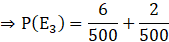
Hence, we have



2% of the items produced by machine A are defective.
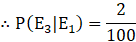


We also have



1% of the items produced by machine A are defective.


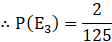
Using the theorem of total probability, we get


P(E3) = P(E1)P(E3|E1) + P(E2)P(E3|E2)



Thus, the probability of the item being defective is.

More from this chapter

All 30 →
26

A laboratory blood test is 99% effective in detecting a certain disease when its infection is present. However, the test also yields a false positive result for 0.5% of the healthy person tested (i.e if a healthy person is tested, then, with probability 0.005, the test will imply he has the disease). If 0.1% of the population actually has the disease, what is the probability that a person has the disease given that his test result is positive?

27

An item is manufactured by three machines A,B and C. Out of the total number of items manufactured during a specified period, 50% are manufacture on machine A, 30% on B and 20% on C. 2% of the items produced on A and 2% of items produced on B are defective and 3% of these produced on C are defective. All the items stored at one godown. One item is drawn at random and is found to be defective. What is the probability that it was manufactured on machine A?

28

Assume that the probability that a bomb dropped from an airplane will strike a certain target is 0.2. If 6 bombs are dropped, find the probability that

i. exactly 2 will strike the target.


ii. at least 2 will strike the target.

30

There are three categories of students in a class of 60 students: A: Very hardworking; B: Regular but not so hardworking; C: Careless and irregular 10 students are in category A, 30 in category B and rest in category C. It is found that the probability of students of category A, unable to get good marks in the final year examination is 0.002, of category B it is 0.02 and of category C, this probability is 0.20. A student selected at random was found to be one who could not get good marks in the examination. Find the probability that this student is of category C.