Q23 of 26 Page 1

Mrs. Rashmi Singh broke her reading glasses. When she went to the shopkeeper to order new specs, he suggested that she should get spectacles with plastic lenses instead of glass lenses. On getting the new spectacles, she found that the new ones were thicker than the earlier ones. She asked this question to the shopkeeper but he could not offer satisfactory explanation for this. At home, Mrs. Singh raised the same question to her daughter Anuja who explained why plastic lenses were thicker.

A. Write two qualities displayed each by Anuja and her mother.


B. How do you explain this fact using lens maker’s formula?

A. The qualities displayed by Anuja is that, she is a knowledgeable student who knows how to apply scientific concepts in daily life applications and is also a co-operative person, and the qualities of her mother is that she is a curious and alert person, she noticed that the thickness of the lenses are increased while the power of the lens was same and she wanted to know about the scientific reason for it.


B. We know that the lensmaker’s formula is,


Where, f is the focal length, is the refractive index of material lens w.r.t material of the surroundings, R1 is the radius of curvature of first surface and R2 is radius of curvature of second surface of the lens, here as the material of the lens is changed from glass to plastic, the refractive index also changes and to maintain the same focal length, the value of R1 and R2 must also change, that is why the lenses are a bit thicker than previous.


More from this chapter

All 26 →
21

For a CE-transistor amplifier, the audio signal voltage across the collector resistance of is 2V. Given the current amplification factor of the transistor is 100, find the input signal voltage and base current, if the base resistance is

22

Describe the working principle of a moving coil galvanometer. Why is it necessary to use (i) a radial magnetic field and (ii) a cylindrical soft iron core in a galvanometer? Write the expression for current sensitivity of the galvanometer.

Can a galvanometer as such be used for measuring the current? Explain.


OR


A. Define the term ‘self-inductance’ and write its S.I. unit.


B. Obtain the expression for the mutual inductance of two long co-axial solenoids and would one over the other, each of length L and radii and and and number of turns per unit length, when a current I is set up in the outer solenoid

24

A. Draw a labeled diagram of AC generator. Derive the expression for the instantaneous value of the emf induced in the coil.


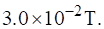
B. A circular coil of cross-sectional area and 20 turns is rotated about the vertical diameter with angular speed of in uniform magnetic field of magnitude Calculate the maximum value of the current in the coil.


OR


A. Draw a labeled diagram of a step-up transformer. Obtain the ratio of secondary to primary voltage in terms of number of turns and currents in the two coils.


B. A power transmission line feeds input power at 2200 V to a step-down transformer with its primary windings having 3000 turns. Find the number of turns in the secondary to get the power output at 220 V.

25

A. Distinguish between unpolarized light and linearly polarized light. How does one get linearly polarised light with the help of a polaroid?

B. A narrow beam of unpolarized light of intensity is incident on a polaroid The light transmitted by it is then incident on a second polaroid with its pass axis making angle of 60o relative to the pass axis of Find the intensity of the light transmitted by .


OR


A. Explain two features to distinguish between the interference pattern in young’s double slit experiment with the diffraction pattern obtained due to a single slit.


B. A monochromatic light of wavelength 500 mm is incident normally on a single slit of width 0.2 mm to produce a diffraction pattern. Find the angular width of the central maximum obtained on the screen.


Estimate the number of fringes obtained in Young’s double slit experiment with fringe width 0.5 mm, which can be accommodated within the region of total angular spread of the central maximum due to single slit. (the wavelength of the light is given in mm but all the calculations are done using it as nm)