
A. Draw a labeled diagram of AC generator. Derive the expression for the instantaneous value of the emf induced in the coil.

B. A circular coil of cross-sectional area  and 20 turns is rotated about the vertical diameter with angular speed of
  in uniform magnetic field of magnitude
  Calculate the maximum value of the current in the coil.
OR
A. Draw a labeled diagram of a step-up transformer. Obtain the ratio of secondary to primary voltage in terms of number of turns and currents in the two coils.
B. A power transmission line feeds input power at 2200 V to a step-down transformer with its primary windings having 3000 turns. Find the number of turns in the secondary to get the power output at 220 V.
A)
The schematic diagram of an AC generator is shown in the above figure. This is an electrical machine which converts mechanical energy into useful electrical energy. AC generator consists of a coil mounted on a rotor shaft. The rotational axis of the coil is kept at 900 to the direction of the magnetic field. The coil (called armature) is mechanically rotated in the uniform magnetic field which can be produced by permanent magnets or electromagnets. The rotation of the coil causes the magnetic flux through it to change, so as per Faraday’s law of electromagnetic induction, an emf is induced in the coil. To connect the coil to the external circuit its ends are connected by slip rings and brushes.
When the coil is rotated with a constant angular speed ω, the angle  between the magnetic field vector B and the area vector A of the coil at any instant t is,

Assuming when the coil was at rest, the angle between B and A was zero. As a result, the effective area of the coil exposed to the magnetic field lines changes with time, and thus, the flux at any time t is

By Faraday’s law of electromagnetic induction,

Thus,
e =N B A ω sin ωt
Considering the peak voltage E0 = B A ω,
e = e0 sin ωt
If the coil is of N turns the formula becomes,
e = N B A ω sin ωt
And the peak voltage becomes e0 = N B A ω
B) using the above formula,
e = N B A ω sin ωt
Where given data is,
B = 3.0 × 10⁻² T
A = 200 × 10-4 m2
ω = 50 rad/s
N = 20 turns, so,
e0 = N B A ω
E0 = 3.0 × 10-2 × 200 × 10-4 × 50 × 20 = 600000 × 10-6
E0 = 0.6 V
Let the resistance of the coil be R, so the peak current in the coil will be,

OR
A) the diagram of a step-up transformer is given below

Transformer uses the principle of mutual induction. A transformer consists of two sets of coils, insulated from each other. They are wound on a soft-iron core, either one on top of the other as shown in the diagram 1 or on separate limbs of the core as shown in the diagram 2. One of the coils called the primary coil has NP turns. The other coil is called the secondary coil; it has NS turns.
For a step-up transformer, NP < NS
Let the associated flux be  , then induced voltage in secondary coil will be

And the back emf generated in the primary coil is,
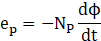
But we know that, ep = vp, so,

So,

Also, in an ideal transformer there is no loss of power so,
iP vP = iS vS
So,

B) using the above relation on the given data is,
vP = 2200 V,
NP = 3000 turns,
vs = 220 V
we get,
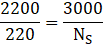
Hence,
NS = 300 turns.
Couldn't generate an explanation.
Generated by AI. May contain inaccuracies — always verify with your textbook.


