
Let C be a curve defined parametrically as x = a cos3 θ, y = a sin3 θ, 0 ≤θ ≤ π/2. Determine a point P on C, where the tangent to C is parallel to the chord joining the points (a, 0) and (0, a). (CBSE 2014)
sin x and cos x functions are continuous everywhere on (−∞, ∞) and differentiable for all arguments.
So both the necessary conditions of Lagrange’s mean value theorem is satisfied.
x = a cos3 θ

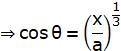
y = a sin3 θ


We know that,
sin2 θ + cos2 θ = 1

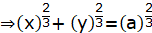
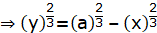

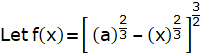

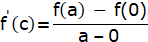
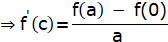
x = acos3 θ
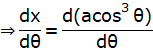


y = asin3 θ




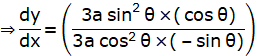
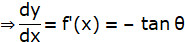
For f’(c), put the value of x=c in f’(x):
f’(c) = – tan θ
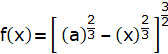
For f(a), put the value of x=a in f(x):

= 0
For f(0), put the value of x=0 in f(x):
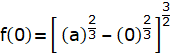

= a
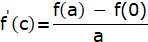
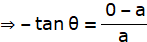

⇒ – tan θ = – 1
⇒ tan θ = 1

Now put the value of θ in the function of x and y:
x = a cos3 θ
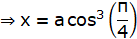


Similarly,
y = a sin3 θ
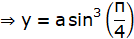
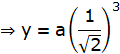


Couldn't generate an explanation.
Generated by AI. May contain inaccuracies — always verify with your textbook.

 (CBSE 2014)
 (CBSE 2014)