Solution of Chapter 6. Triangles (NCERT - Mathematics Exemplar Book)
Chapter Exercises
Exercise 6.1
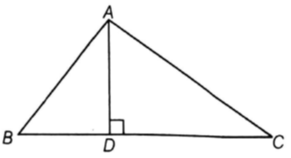
In figure, if ∠BAC = 90° and AD ⊥ BC. Then,
If the lengths of the diagonals of rhombus are 16 cm and 12 cm. Then, the length of the sides of the rhombus is
view answer >If ∆ABC ∼ ∆EDF and ∆ABC is not similar to ∆DEF, then which of the following is not true?
view answer >If in two  then
then
In figure, two-line segments AC and BD intersect each other at the point P such that PA = 6 cm, PB = 3 cm, PC = 2.5 cm, PD = 5 cm, ∠APB = 50° and ∠CDP = 30°. Then, ∠PBA is equal to

If in two ∆DEF and ∆PQR, ∠D = ∠Q and ∠R = ∠E, then which of the following is not true?
view answer >In the ∆ABC and ∆DEF, ∠B = ∠E, ∠F = ∠C and AB = 3DE. Then, the two triangles are
view answer >If ∆ABC ∼ ∆PQR with 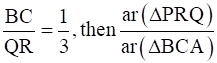 is equal to
If ∆ABC ∼ ∆DFE, ∠A = 30°, ∠C = 50°, AB = 5 cm, AC = 8 cm and DF = 7.5 cm. Then, which of the following is true?
view answer >If in ∆ABC and ∆DEF, then they will be similar, when
view answer >If ∆ABC ∼ ∆QRP, AB = 18 cm and BC = 15 cm, then PR is equals to,
view answer >If S is a point on side PQ of a ∆PQR such that PS = QS = RS, then
view answer >Exercise 6.2
Is the triangle with sides 25 cm, 5 cm and 24 cm a right triangle? Give reason for your answer.
view answer >It is given that ∆DEF ∼ ∆RPQ. Is it true to say that ∠D = ∠R and ∠F = ∠P? Why?
view answer >A and B are respectively the points on the sides PQ and PR of a ∆PQR such that PQ = 12.5 cm, PA = 5 cm, BR = 6 cm and PB = 4 cm, Is AB || QR? Give reason for your answer.
view answer >In figure, BD and CE intersect each other at the point P. Is ∆PBC ∼ ∆PDE?
Why?

In ∆PQR and ∆MST, ∠P = 55°, ∠Q = 25°, ∠M = 100° and ∠S = 25°. Is ∆QPR ∼ ∆TSM? Why? (True)
view answer >Is the following statement true? Why? ‘‘Two quadrilaterals are similar, if their corresponding angles are equal’’.
view answer >Two sides and the perimeter of one triangle are respectively three times the corresponding sides and the perimeter of the other triangle. Are the two triangles similar? Why?
view answer >If in two right triangles, one of the acute angles of one triangle is equal to an acute angle of the other triangle. Can you say that two triangles will be similar? Why?
view answer >The ratio of the corresponding altitudes of two similar triangles is . Is it correct to say that ratio of their areas is ? Why?
view answer >D is a point on side QR of ∆PQR such that PD ⊥ QR. Will it be correct to say that ∆PQD ∼ ∆RPD? Why?
view answer >In figure, if ∠D = ∠C, then it is true that ∆ADE ∼ ∆ACB? Why?

Is it true to say that, if in two triangles, an angle of one triangle is equal to an angle of another triangle and two sides of one triangle are proportional to the two sides of the other triangle, then the triangles are similar? Give reason for your answer.
view answer >Exercise 6.3
In a ∆PQR, PR2 = QR2 and M is a point on side PR such that QM ⊥ PR. Prove that QM2 = PMXMR.
view answer >Find the value of x for which DE || AB in given figure.
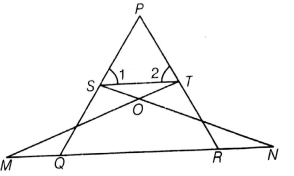
view answer >In figure, if ∠1 = ∠2 and ∆NSQ ≅ ∆MTR, then prove that ∆PTS ∼ ∆PRQ.
Diagonals of a trapezium PQRS intersect each other at at the point 0, PQ‖RS and PQ = 3RS. Find the ratio of the areas of ∆POQ and ∆ROS.
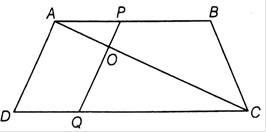
view answer >In figure, if AB‖DC and AC, PQ intersect each other at the point 0. Prove that 0A. CQ = OC.AP.
Find the altitude of an equilateral triangle of side 8 cm.
view answer >If ∆ABC ∼ ∆DEF, AB = 4 cm, DE = 6, EF = 9 cm and FD = 12 cm, then find the perimeter of ∆ABC.
view answer >In figure, if DE || BC, then find the ratio of ar(∆ADE) and ar(DECB).
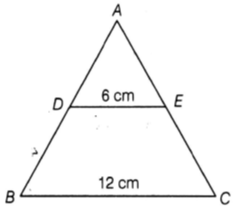
ABCD is a trapezium in which AB‖DC and P, Q are points on AD and BC respectively, such that PQ || DC, if PD = 18 cm, BQ = 35 cm and QC = 15 cm, find AD.
view answer >Corresponding sides of two similar triangles are in the ratio of 2:3. If the area of the smaller triangle is 48 cm2, then find the area of the larger triangle.
view answer >In a ∆PQR, N is a point on PR, such that QN ⊥ PR. If PN.NR = QN2, then prove that ∠PQR = 90°.
view answer >Areas of two similar triangles are 36 cm2 and 100 cm2. If the length of a side of the larger triangle is 20 cm. Find the length of the corresponding side of the smaller triangle.
view answer >In given figure, if ∠ACB = ∠CDA, AC = 8 cm and AD = 3cm, then find BD.
view answer >A 15 high tower casts a shadow 24 long at a certain time and at the same time, a telephone pole casts a shadow 16 long. Find the height of the telephone pole.
view answer >Foot of a 10 m long ladder leaning against a vertical well is 6 m away from the base of the wall. Find the height of the point on the wall where the top of the ladder reaches.
view answer >Exercise 6.4
In given figure, if ∠A = ∠C, AB = 6 cm, BP = 15 cm, AP = 12 cm and CP = 4 cm, then find the lengths of PD and CD.
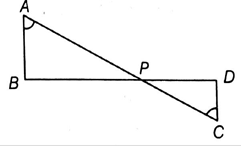
It is given that ∆ABC ∼ ∆EDF such that AB = 5 cm, AC = 7 cm, DF = 15 cm and DE = 12 cm. find the lengths of the remaining sides of the triangle.
view answer >Prove that, if a line is drawn parallel to one side of a triangle to intersect the other two sides, then the two sides are divided in the same ratio.
view answer >In the given figure, if PQRS is a parallelogram and AB || PS, then prove that OC || SR.
view answer >A 5 m long ladder is placed leaning towards a vertical wall such that it reaches the wall at a point 4 m high. If the foot of the ladder is moved 1.6 m towards the wall, then find the distance by which the top of the ladder would slide upwards on the wall.
view answer >For going to a city B from city A there is a route via city C such that AC⊥CB, AC = 2x km and CB = 2(x + 7) km. It is proposed to construct a 26 km highway which directly connects the two cities A and B. find how much distance will be saved in reaching city B from city A after the construction of the highway.
view answer >A flag pole 18 m high casts a shadow 9.6 m long. Find the distance of the top of the pole from the far end of the shadow.
view answer >A street light bulb is fixed on a pole 6 m. above the level of the street. If a woman of height 1.5 m casts a shadow of 3 m, then find how far she is away from the base of the pole.
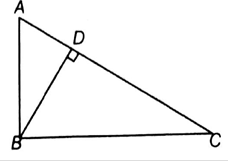
view answer >In given figure, ABC is triangle right angled at B and BD ⊥ AC. If AD = 4 cm and CD = 5 cm, then find BD and AB.
In given figure, PQR is a right triangle, right angled at Q and QS ⊥ PR. If PQ = 6 cm and PS = 4 cm, then find QS, RS and QR.

In ∆PQR, PD ⊥ QR such that D lies on QR, if PQ = a, PR = b, QD = c and DR = d, then prove that (a + b)(a - b) = (c + d)(c - d).
view answer >In a quadrilateral ABCD, ∠A + ∠D = 90°. Prove that AC2 + BD2 = AD2 + BC2.
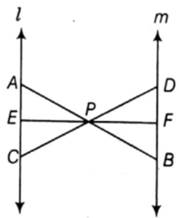
view answer >In given figure, ⎩||m and line segments AB, CD and EF are concurrent at point p. prove that
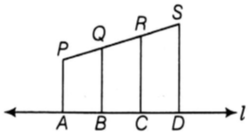
In figure, PA, QB, RC and SD are all perpendiculars to a line ⎩, AB = 6 cm, BC = 9 cm, CD = 12 cm and SP = 36 cm. Find PQ, QR and RS.
0 is the point of intersection of the diagonals AC and BD of a trapezium ABCD with AB || DC. Through 0, a line segment PQ is drawn parallel to AB meeting AD in Point and BC in Q, prove that PO = QO.
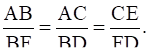
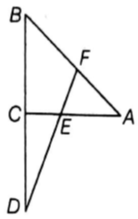
view answer >In figure, line segment DF intersects the side AC of a ∆ABC at the point E such that E is the mid-point of CA and ÐAEF = ÐAFE. Proved that
Prove that the area of the semi-circle drawn on the hypotenuse of a right-angled triangle is equal to the sum of the areas of the semi-circles drawn on the other two sides of the triangle.
view answer >Prove that the area of the equilateral triangle drawn on the hypotenuse of a right angled triangle is equal to the sum of the areas of the equilateral triangle drawn on the other two sides of the triangle.
view answer >