Solution of Chapter 11. Three Dimensional Geometry (Mathematics Part-II Book)
Chapter Exercises
Exercise 11.1
If a line makes angles 90°, 135°, 45° with the x, y and z-axes respectively, find its direction cosines.
view answer >Find the direction cosines of a line which makes equal angles with the coordinate axes.
view answer >If a line has the direction ratios –18, 12, –4, then what are its direction cosines?
view answer >Show that the points (2, 3, 4), (–1, –2, 1), (5, 8, 7) are collinear.
view answer >Find the direction cosines of the sides of the triangle whose vertices are (3, 5, –4), (-1, 1, 2) and (–5, –5, –2).
view answer >Exercise 11.2
Show that the three lines with direction cosines  are mutually perpendicular.
Show that the line through the points (1, –1, 2), (3, 4, –2) is perpendicular to the line through the points (0, 3, 2) and (3, 5, 6).
view answer >Show that the line through the points (4, 7, 8), (2, 3, 4) is parallel to the line through the points (–1, –2, 1), (1, 2, 5).
view answer >Find the equation of the line which passes through the point (1, 2, 3) and is parallel to the vector 
Find the equation of the line in vector and in cartesian form that passes through the point with position vector  and is in the direction
Find the cartesian equation of the line which passes through the point (–2, 4, –5) and parallel to the line given by 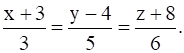
The Cartesian equation of a line is  . Write its vector form.
Find the vector and the cartesian equations of the lines that passes through the origin and (5, –2, 3).
view answer >. Find the vector and the cartesian equations of the line that passes through the points (3, –2, –5), (3, –2, 6).
view answer >Find the angle between the following pairs of lines:

. Find the angle between the following pair of lines:
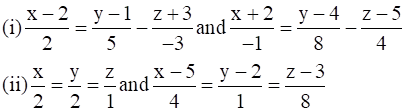
Find the values of p so that the lines  are at right angles.
Show that the lines  are perpendicular to each other.
Find the shortest distance between the lines

Find the shortest distance between the lines

Find the shortest distance between the lines whose vector equations are

Find the shortest distance between the lines whose vector equations are

Exercise 11.3
In each of the following cases, determine the direction cosines of the normal to the plane and the distance from the origin.
z = 2
view answer >In each of the following cases, determine the direction cosines of the normal to the plane and the distance from the origin.
x + y + z = 1
view answer >In each of the following cases, determine the direction cosines of the normal to the plane and the distance from the origin.
2x + 3y – z = 5
view answer >In each of the following cases, determine the direction cosines of the normal to the plane and the distance from the origin.
5y + 8 = 0
view answer >Find the vector equation of a plane which is at a distance of 7 units from the origin and normal to the vector 
Find the Cartesian equation of the following planes:

Find the Cartesian equation of the following planes:

Find the Cartesian equation of the following planes:

In the following cases, find the coordinates of the foot of the perpendicular drawn from the origin.
2x + 3y + 4z – 12 = 0
view answer >In the following cases, find the coordinates of the foot of the perpendicular drawn from the origin.
2x + 3y + 4z – 12 = 0
view answer >In the following cases, find the coordinates of the foot of the perpendicular drawn from the origin.
3y + 4z – 6 = 0
view answer >In the following cases, find the coordinates of the foot of the perpendicular drawn from the origin.
x + y + z = 1
view answer >Find the vector and cartesian equations of the planes
that passes through the point (1, 0, –2) and the normal to the plane is 
Find the vector and cartesian equations of the planes
that passes through the point (1,4, 6) and the normal vector to the plane is 
Find the equations of the planes that passes through three points.
(1, 1, –1), (6, 4, –5), (–4, –2, 3)
view answer >Find the equations of the planes that passes through three points.
(1, 1, 0), (1, 2, 1), (–2, 2, –1)
view answer >Find the intercepts cut off by the plane 2x + y – z = 5.
view answer >Find the equation of the plane with intercept 3 on the y-axis and parallel to ZOX plane.
view answer >Find the equation of the plane through the intersection of the planes 3x – y + 2z – 4 = 0 and x + y + z – 2 = 0 and the point (2, 2, 1).
view answer >Find the vector equation of the plane passing through the intersection of the planes  and through the point (2, 1, 3).
Find the equation of the plane through the line of intersection of the planes x + y + z = 1 and 2x + 3y + 4z = 5 which is perpendicular to the plane x – y + z = 0.
view answer >Find the angle between the planes whose vector equations are 
In the following cases, determine whether the given planes are parallel or perpendicular, and in case they are neither, find the angles between them.
7x + 5y + 6z + 30 = 0 and 3x – y – 10z + 4 = 0
view answer >In the following cases, determine whether the given planes are parallel or perpendicular, and in case they are neither, find the angles between them.
2x + y + 3z – 2 = 0 and x – 2y + 5 = 0
view answer >In the following cases, determine whether the given planes are parallel or perpendicular, and in case they are neither, find the angles between them.
2x – 2y + 4z + 5 = 0 and 3x – 3y + 6z – 1 = 0
view answer >In the following cases, determine whether the given planes are parallel or perpendicular, and in case they are neither, find the angles between them.
2x – 2y + 4z + 5 = 0 and 3x – 3y + 6z – 1 = 0
view answer >In the following cases, determine whether the given planes are parallel or perpendicular, and in case they are neither, find the angles between them.
4x + 8y + z – 8 = 0 and y + z – 4 = 0
view answer >In the following cases, find the distance of each of the given points from the corresponding given plane.
Point Plane
(0, 0, 0) 3x – 4y + 12 z = 3
view answer >In the following cases, find the distance of each of the given points from the corresponding given plane.
Point Plane
(3, – 2, 1) 2x – y + 2z + 3 = 0
view answer >In the following cases, find the distance of each of the given points from the corresponding given plane.
Point Plane
(2, 3, – 5) x + 2y – 2z = 9
view answer >In the following cases, find the distance of each of the given points from the corresponding given plane.
Point Plane
(–6, 0, 0) 2x – 3y + 6z – 2 = 0
view answer >Miscellaneous Exercise
Show that the line joining the origin to the point (2, 1, 1) is perpendicular to the line determined by the points (3, 5, –1), (4, 3, –1).
view answer >If l1, m1, n1 and l2, m2, n2 are the direction cosines of two mutually perpendicular lines, show that the direction cosines of the line perpendicular to both of these are (m1n2 - m2n1), (n1l2 - n2l1), (l1m2 - l2m1)
view answer >Find the angle between the lines whose direction ratios are a, b, c and b – c, c – a, a – b.
view answer >Find the equation of a line parallel to x - axis and passing through the origin.
view answer >If the coordinates of the points A, B, C, D be (1, 2, 3), (4, 5, 7), (–4, 3, –6) and (2, 9, 2) respectively, then find the angle between the lines AB and CD.
view answer >If the lines  and
and  are perpendicular, find the value of k.
Find the vector equation of the line passing through (1, 2, 3) and perpendicular to the plane  .
.
Find the equation of the plane passing through (a, b, c) and parallel to the plane  .
.
Find the shortest distance between lines
 and
and  .
.
Find the coordinates of the point where the line through (5, 1, 6) and (3, 4,1) crosses the YZ - plane.
view answer >Find the coordinates of the point where the line through (5, 1, 6) and (3, 4, 1) crosses the ZX - plane.
view answer >Find the coordinates of the point where the line through (3, –4, –5) and (2, –3, 1) crosses the plane 2x + y + z = 7.
view answer >Find the equation of the plane passing through the point (–1, 3, 2) and perpendicular to each of the planes x + 2y + 3z = 5 and 3x + 3y + z = 0.
view answer >If the points (1, 1, p) and (–3, 0, 1) be equidistant from the plane  , then find the value of p.
Find the equation of the plane passing through the line of intersection of the planes  and
and  and parallel to x-axis.
If O be the origin and the coordinates of P be (1, 2, –3), then find the equation of the plane passing through P and perpendicular to OP.
view answer >Find the equation of the plane which contains the line of intersection of the planes  and
and  . And which is perpendicular to the plane
  .
.
Find the distance of the point (–1, –5, –10) from the point of intersection of the line  and the plane
  .
.
Find the vector equation of the line passing through (1, 2, 3) and parallel to the planes s and
and  .
.
Find the vector equation of the line passing through the point (1, 2, – 4) and perpendicular to the two lines:
 and
and  .
.
Prove that if a plane has the intercepts a, b, c and is at a distance of p units from the origin, then 
Distance between the two planes: 2x + 3y + 4z = 4 and 4x + 6y + 8z = 12 is
view answer >The planes: 2x – y + 4z = 5 and 5x – 2.5y + 10z = 6 are
view answer >