
If p, q, r are in AP, then prove that pth, qth and rth terms of any GP are in GP.
To prove: pth, qth and rth terms of any GP are in GP.
Given: (i) p, q and r are in AP
The formula used: (i) General term of GP, 
As p, q, r are in A.P.
⇒ q – p = r – q = d = common difference … (i)
Consider a G.P. with the first term as a and common difference R
Then, the pth term will be 
the qth term will be 
the rth term will be 
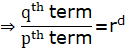
Considering pth term and qth term
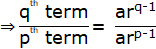

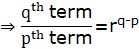
From eqn. (i) q – p = d
Considering qth term and rth term
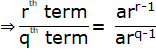


From eqn. (i) r – q = d
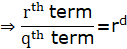
We can see that pth, qth and rth terms have common ration i.e 
Hence they are in G.P.
Hence Proved
Couldn't generate an explanation.
Generated by AI. May contain inaccuracies — always verify with your textbook.

