
Show that the points A(2, -1), B(3, 4), C(-2, 3) and D(-3, -2) are the vertices of a rhombus.
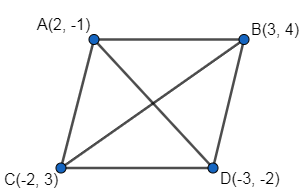
Given: Vertices of the quadrilateral are A(2, -1), B(3, 4), C(-2, 3) and D(-3, -2).
Note: For a quadrilateral to be a rhombus, all the sides must be equal in length and the diagonals must not be equal.
AB 
= √26 units
BC 
= √26 units
CD 
= √26 units
DA 
= √26 units
Therefore, AB = BC = CD = DA …..(1)
AC 
= 4√2 units
BD 
= 6√2 units
Also, AC  BD …..(2)
From 1 and 2, we have all the sides are equal and diagonals are not equal.
Hence, the points A, B, C and D are the vertices of a rhombus.
AI is thinking…
Couldn't generate an explanation.
Generated by AI. May contain inaccuracies — always verify with your textbook.