
#Mark the correct alternative in each of the following
Let x, y be two variables and x > 0, xy = 1, then minimum value of x + y is
xy=1, x>0, y>0
⇒ 
x+y=
Let 
Differentiating f(x) with respect to x, we get
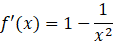
Also, differentiating f’(x) with respect to x, we get

For minima at x=c, f’(c)=0 and f’’(c)<0
⇒  or
or  (Since x>0)
f’’(1)=2>0
Hence, x=1 is a point of minima for f(x) and f(1)=2 is the minimum value of f(x) for x>0.
AI is thinking…
Couldn't generate an explanation.
Generated by AI. May contain inaccuracies — always verify with your textbook.


