Q30 of 91 Page 230

A particle having a charge of 2.0 × 10⁻⁸ C and a mass of 2.0 ×10⁻¹⁰ g is projected with a speed of 2.0 × 10³ ms–1 in a region having a uniform magnetic field of 0.10 T. The velocity is perpendicular to the field. Find the radius of the circle formed by the particle and also the time period.

Given-


Charge on the particle, q = 2.0 × 10⁻⁸ C


Mass of the particle, m = 2.0 × 10⁻¹⁰ g


velocity of the particle when projected, v = 2.0 × 10³ m s−1


Magnetic field, B = 0.10 T.


Given in the question that, the velocity is perpendicular to the field.


So, for the particle to move in a circle, the centrifugal force comes into acts which is provided by the magnetic force acting on it.


Also magnetic force, we know, Lorentz force F is given by -



where,


e = charge on an electron


v = velocity of the electron


B=magnetic field


Using the formula for centrifugal force


where,


v= velocity of the particle


r= radius of circle form


m =mass of the electron


Equating the two forces, we will get-


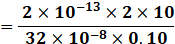
Now,


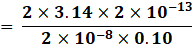
Time period,


More from this chapter

All 91 →
28

A conducting wire of length ℓ, lying normal to a magnetic field B, moves with velocity v as shown in figure.

(a) Find the average magnetic force on a free electron of the wire.


(b) Due to this magnetic force, electrons concentrate at one end resulting in the electric field inside the wire. The redistribution stops when the electric force on the free electrons balances the magnetic force. Find the electric field developed inside the wire when the redistribution stops.


(c) What potential difference is developed between the ends of the wire?


29

A current i is passed through a silver strip of width d and area of cross section A. The number of free electrons per unit volume is π.

(a) Find the drift velocity v of the electrons.


(b) If a magnetic field B exists in the region as shown in figure, what is the average magnetic force on the free electrons?


(c) Due to the magnetic force, the free electrons get accumulated on one side of the conductor along its length. This produces a transverse electric field in the conductor which opposes the magnetic force on the electrons. Find the magnitude of the electric field which will stop further accumulation of electrons.


(d) What will be the potential difference developed across the width of the conductor due to the electron-accumulation? The appearance of a transvers emf, when a current carrying wire is placed in a magnetic field, is called Hall effect.


31

A proton describes a circle of radius 1 cm is a magnetic field of strength 0.10 T. What would be the radius of the circle described by an α-particle moving with the same speed in the same magnetic field?

32

An electron having a kinetic energy of 100 eV circulates in a path of radius 10 cm in a magnetic field. Find the magnetic field and the number of revolutions per second made by the electron.