Q41 of 91 Page 230

Fe+ions are acceleration through a potential difference of 500 V and are injected normally into a homogeneous magnetic field B of strength 20.0 mT. Find the radius of the circular paths followed by the isotopes with mass numbers 57 and 58. Take the mass of an ion = A(1.6 × 10⁻²⁷) kg where A is the mass number.

Given-
Potential difference through which the Fe+, V = 500 V


Strength of the homogeneous magnetic field


B = 20.0 mT= 20 × 10−3 T


Mass numbers of the two isotopes ,


m1 =57 and m2 =58.


Mass of an ion = A (1.6 × 10⁻²⁷) kg


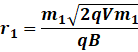
The radius of the circular path described by a particle in a magnetic field,


where,


m is the mass of a proton


v= velocity of the particle


B = magnetic force


q= charge on the particle = C


For calculating the radius of isotope 1-


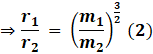
For isotope 2,


Since isotopes are accelerated from the same potential V, the Kinetic energy gained by the two particles will be same for both the particles.


We, know the force developed by potential difference –


where


v = applied potential


q=charge



Also,we have


From (1)


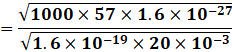
For calculating the radius of 2 isotope-


From (2)


More from this chapter

All 91 →
39

A particle of mass m and charge q is projected into a region having a perpendicular magnetic field B. Find the angle of deviation figure of the particle as it comes out of the magnetic field if the width d of the region is very slightly smaller than

(a) (b).


(c)


40

A narrow beam of singly charged carbon ions, moving at a constant velocity of 6.0 × 10⁴ms–1, is sent perpendicularly in a rectangular region having uniform magnetic field B = 0.5 T figure. It is found that two beams emerge from the field in the backward direction, the separations from the incident beam being 3.0 cm and 3.5 cm. Identify the isotopes present in the ion beam. Take the mass of an ion = A(1.6 × 10⁻²⁷) kg, where A is the mass number.


42

A narrow beam of singly charged potassium ions of kinetic energy 32 keV is injected into a region of width 1.00 cm having a magnetic field of strength 0.500 T as shown in figure. The ions are collected at a screen 95.5 cm away form the field region. If the beam contains isotopes of atomic weights 39 and 41, find the separation between the points where these isotopes strike the screen. Take the mass of a potassium ion = A(1.6 × 10⁻²⁷) kg where A is the mass number.


43

Figure shows a convex lens of focal length 12 cm lying in a uniform magnetic field B of magnitude 1.2 T parallel to tis principal axis. A particle having a charge 2.0 × 10⁻³ C and mass 2.0 × 10⁻⁶ kg is projected perpendicular to the plane of the diagram with a speed of 4.8 ms–1. The particle moves along a circle with its centre on the principal axis at a distance of 18 cm from the lens. Show that the image of the particle goes along a circle and find the radius of that circle.