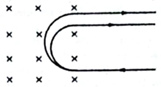
A narrow beam of singly charged potassium ions of kinetic energy 32 keV is injected into a region of width 1.00 cm having a magnetic field of strength 0.500 T as shown in figure. The ions are collected at a screen 95.5 cm away form the field region. If the beam contains isotopes of atomic weights 39 and 41, find the separation between the points where these isotopes strike the screen. Take the mass of a potassium ion = A(1.6 × 10⁻²⁷) kg where A is the mass number.

Given -
Kinetic energy of singly-charged potassium ions = 32 keV
Width of the magnetic region = 1.00 cm
Magnetic field’s strength, B = 0.500 T
Distance between the screen and the region = 95.5 cm
Atomic weights of the two isotopes are m1 =39 and m2 =41
.Mass of a potassium ion = A (1.6 × 10⁻²⁷) kg
For a singly-charged potassium ion K-39, separation between the points can be calculated as follows –
Mass of K-39 = 39 × 1.6 × 10−27 kg
Charge, q = 1.6 × 10⁻¹⁹ C
Given in the question that the narrow beam of singly-charged potassium ions is injected into a region of magnetic field.
As, given that kinetic energy K.E is
K.E = 32 keV



We know that throughout the motion, the horizontal velocity remains constant.
So, the time taken to cross the magnetic field,



Now, the acceleration in the magnetic field region-




Now, velocity in the vertical direction can be found from Newton’s 2nd law as

Since, initial velocity is 0,

Substituting the values-


Time taken by the ion to reach the screen-

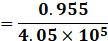

Now, distance moved by the ion vertically in this given time -


Vertical distance travelled by the particle inside magnetic field
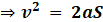
can be calculated by using 3rd equations of motion –

where,
v= final velocity
u=initial velocity
a= acceleration acting on the ion
S=distance travelled
Since initial velocity is zero,


Now, time taken t,


Now,for the potassium ion K-41



And, acceleration a is given by-

t = time taken by the ion to exit the magnetic field is given by -

From newton’s law velocity in vertical direction-



Time to reach the screen, t -
 .
.
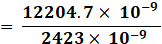
Now distance moved in vertical direction is-

Now,
Vertical distance travelled by the particle inside magnetic field can be found out by using 3rd equation of motion given by

where,
v= final velocity
u=initial velocity
a= acceleration acting on the ion
S=distance travelled
Since initial velocity is zero,



Net distance travelled by K-41 potassium ion


Net gap between K-39 and K-41 potassium ions is given by-
From (1) and (2)


Couldn't generate an explanation.
Generated by AI. May contain inaccuracies — always verify with your textbook.