Q43 of 91 Page 230

Figure shows a convex lens of focal length 12 cm lying in a uniform magnetic field B of magnitude 1.2 T parallel to tis principal axis. A particle having a charge 2.0 × 10⁻³ C and mass 2.0 × 10⁻⁶ kg is projected perpendicular to the plane of the diagram with a speed of 4.8 ms–1. The particle moves along a circle with its centre on the principal axis at a distance of 18 cm from the lens. Show that the image of the particle goes along a circle and find the radius of that circle.


Given-
Focal length of the convex lens = 12 cm


Uniform magnetic field, B = 1.2 T


Charge of the particle, q = 2.0 × 10⁻³ C


an mass, m = 2.0 × 10⁻⁵ kg


Speed of the particle, v = 4.8 m s−1


Distance between the particle and the lens = 18 cm


Given in the question that the object is projected perpendicularly on the plane of the paper.


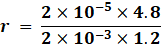
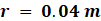
The radius of the circular path described by a particle in a magnetic field r,


where,


m is the mass of a proton


v= velocity of the particle


B = magnetic force


q= charge on the particle = C


Given that, the object distance, u = -18 cm


Using the lens formula –


where,


v=distance of image formed from lens


u=distance of the object from lens


f =focal length of the lens


substituting the values-


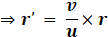
Let the radius of the circular path of image be r’.


Hence magnification -


Therefore, the radius of the circular path in which the image of the object formed from the lens moves is 8 cm.


More from this chapter

All 91 →
41

Fe+ions are acceleration through a potential difference of 500 V and are injected normally into a homogeneous magnetic field B of strength 20.0 mT. Find the radius of the circular paths followed by the isotopes with mass numbers 57 and 58. Take the mass of an ion = A(1.6 × 10⁻²⁷) kg where A is the mass number.

42

A narrow beam of singly charged potassium ions of kinetic energy 32 keV is injected into a region of width 1.00 cm having a magnetic field of strength 0.500 T as shown in figure. The ions are collected at a screen 95.5 cm away form the field region. If the beam contains isotopes of atomic weights 39 and 41, find the separation between the points where these isotopes strike the screen. Take the mass of a potassium ion = A(1.6 × 10⁻²⁷) kg where A is the mass number.


44

Electrons emitted with negligible speed from an electron gun are acceleration through a potential difference V


Along the x-axis. These electrons emerge form a narrow hole into a uniform magnetic field B directed along this axis. However, some of the electrons emerging from the hole make slightly divergent angles as shown in figure. Show that these paraxial electrons are refocused on the x-axis at a distance.


45

Two particles, each having a mass m are placed at a separation d in a uniform magnetic filed B as shown in figure. They have opposite charges of equal magnitude q. At time t = 0, the particles are projected towards each other, each with a speed v. Suppose the Coulomb force between the charges is switched off.

(a) Find the maximum value vm of the projection speed so that the two particles do not collide.


(b) What would be the minimum and maximum separation between the particles if v = vm/2 ?


(c) At what instant will a collision occur between the particles if v = 2vm?


(d) Suppose v = 2vm and the collision between the particles is completely inelastic. Describe the motion after the collision.