Q44 of 48 Page 48

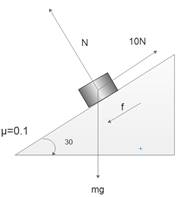
A block of mass 1 kg is pushed up a surface inclined to horizontal at an angle of 30° by a force of 10 N parallel to the inclined surface (Fig. 6.15). The coefficient of friction between block and the incline is 0.1. If the block is pushed up by 10 m along the incline, calculate

(a) work done against gravity


(b) work done against force of friction


(c) increase in potential energy


(d) increase in kinetic energy


(e) work done by applied force.


Mass of the block m = 1kg


Angle of inclination =


Coefficient of friction = 0.1


Displacement = 10 m


a) Work done against gravity


=


b) Work done against friction


=



c) Vertical raise in height h


change in P.E.


d) Applying work energy theorem,



-(1)


Putting these in equation (1),


We get,



there is a decrease in the kinetic energy by 41.3 J


e) Applied force F =


Displacement d =


Work done W by the force F is given as


=


=



More from this chapter

All 48 →
42

An adult weighing 600N raises the centre of gravity of his body by 0.25 m while taking each step of 1 m length in jogging. If he jogs for 6 km, calculate the energy utilised by him in jogging assuming that there is no energy loss due to friction of ground and air. Assuming that the body of the adult is capable of converting 10% of energy intake in the form of food, calculate the energy equivalents of food that would be required to compensate energy utilised for jogging.

43

On complete combustion a litre of petrol gives off heat equivalent to 3×10⁷ J. In a test drive a car weighing 1200 kg. including the mass of driver, runs 15 km per litre while moving with a uniform speed on a straight track. Assuming that friction offered by the road surface and air to be uniform, calculate the force of friction acting on the car during the test drive, if the efficiency of the car engine were 0.5.

45

A curved surface is shown in Fig. 6.16. The portion BCD is free of friction. There are three spherical balls of identical radii and masses. Balls are released from rest one by one from A which is at a slightly greater height than C.


With the surface AB, ball 1 has large enough friction to cause rolling down without slipping; ball 2 has a small friction and ball 3 has a negligible friction.


(a) For which balls is total mechanical energy conserved?


(b) Which ball(s) can reach D?


(c) For balls which do not reach D, which of the balls can reach back A?


46

A rocket accelerates straight up by ejecting gas downwards. In a small time interval ∆t, it ejects a gas of mass ∆m at a relative speed u. Calculate KE of the entire system at t + ∆t and t and show that the device that ejects gas does work = ∆m u2 in this time interval (neglect gravity).