Q14 of 71 Page 418

The conductivity of an intrinsic semiconductor depends on temperature as σ = σ0 e–ΔE/2kT, where σ0 is a constant. Find the temperature at which the conductivity of an intrinsic germanium semiconductor will be double of its value at T = 300 K. Assume that the gap for germanium is 0.650 eV and remains constant as the temperature is increased.

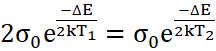
Let T1=300K and T2=temperature at which the conductivity will be double of its value at T1.

And let the conductivities at temperatures T1 and T2 be σ1 and σ2 respectively.


We are given,


Band gap, ΔE= 0.650 eV


12


Taking natural log both sides,


-11.874525


On solving, we get T2=317.512K.


More from this chapter

All 71 →
12

Estimate the proportion of boron impurity which will increase the conductivity of a pure silicon sample by a factor of 100. Assume that each boron atom creates a hole and the concentration of holes in pure silicon at the same temperature is 7 × 10¹⁵ holes per cubic meter. Density of silicon is 5 × 1028 atoms per cubic meter.

13

The product of the hole concentration and the conduction electron concentration turns out to be independent of the amount of any impurity doped. The concentration of conduction electrons in germanium is 6 × 10¹⁹ per cubic meter. When some phosphorus impurity is doped into a germanium sample, the concentration of conduction electrons increases to 2 × 10²³ per cubic meter. Find the concentration of the holes in the doped germanium.

15

A semiconducting material has a band gap of 1 eV. Acceptor impurities are doped into it which create acceptor levels 1 meV above the valence band. Assumed that the transition from one energy level to the other is almost forbidden if kT is less than 1/50 of the energy gap. Also, if kT is more than twice the gap, the upper levels have maximum population. The temperature of the semiconductor is increased from 0K. The concentration of the holes increase with temperature and after a certain temperature it becomes approximately constant. As the temperature is further increased, the hole concentration again starts increasing at a certain temperature. Find the order of the temperature range in which the hole concentration remains approximately constant.

16

In a p-n junction, the depletion region is 400 nm wide and an electric field of 5 × 10⁵ V m–1 exists in it.

(a) Find the height of the potential barrier.


(b) What should be the minimum kinetic energy of a conduction electron which can diffuse from the n-side to the p-side.