Q36 of 40 Page 93

Suppose a ‘n’-type wafer is created by doping Si crystal having 5 × 1028 atoms/m3 with 1ppm concentration of As. On the surface 200 ppm Boron is added to create ‘P’ region in this wafer. Considering ni = 1.5 × 10¹⁶ m–3, (i) Calculate the densities of the charge carriers in the n & p regions. (ii) Comment which charge carriers would contribute largely for the reverse saturation current when diode is reverse biased.

i) Each arsenic atom will provide on electron. Hence, density of electrons will be


We also know that


So density of holes in this side will be,


When boron is added to the other side then each atom will contribute to one hole. So, density of holes will be,


Now the concentration of electrons will be,


ii) Density of holes in n region is


Density of electron in p region is


So, holes in n region will contribute more to the reverse saturation current.


More from this chapter

All 40 →
34

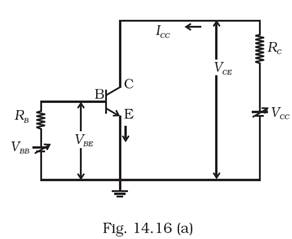
Consider the circuit arrangement shown in Fig 14.16 (a) for studying input and output characteristics of n-p-n transistor in CE configuration.


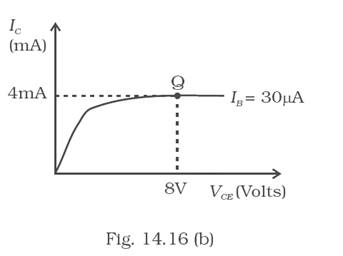
Select the values of RB and RC for a transistor whose VBE = 0.7 V, so that the transistor is operating at point Q as shown in the characteristics shown in Fig. 14.16 (b).


Given that the input impedance of the transistor is very small and VCC = VBB = 16 V, also find the voltage gain and power gain of circuit making appropriate assumptions.


35

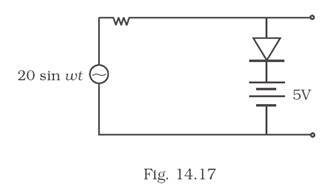
Assuming the ideal diode, draw the output waveform for the circuit given in Fig. 14.17. Explain the waveform.


37

An X-OR gate has following truth table:

It is represented by following logic relation


Build this gate using AND, OR and NOT gates.


38

Consider a box with three terminals on top of it as shown in Fig.14.18 (a):


Three components namely, two germanium diodes and one resistor are connected across these three terminals in some arrangement.


A student performs an experiment in which any two of these three terminals are connected in the circuit shown in Fig. 14.18 (b).


The student obtains graphs of current-voltage characteristics for unknown combination of components between the two terminals connected in the circuit.


The graphs are


(i) when A is positive and B is negative


(ii) when A is negative and B is positive


(iii) When B is negative and C is positive


(iv) When B is positive and C is negative


(v) When A is positive and C is negative


(vi) When A is negative and C is positive


From these graphs of current – voltage characteristic shown in Fig. 14.18 (c) to (h), determine the arrangement of components between A, B and C.