Q14 of 97 Page 323

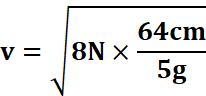
A steel wire of length 64 cm weights 5 g. If it is stretched by a force of 8 N, what would be the speed of a transverse wave passing on it?

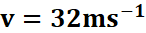
32 m s1

Mass=5g


Length=64cm


So, density will be,


Force applied is


Now,


More from this chapter

All 97 →
12

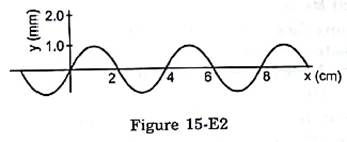
Figure (15-E2) shows a plot of the transverse displacements of the particles of a string at t = 0 through which a travelling wave is passing in the positive x-direction. The wave speed is 20 cm s1. Find (A) the amplitude, (B) the wavelength, (C) the wave number and (D) the frequency of the wave.


13

A wave travelling on a string at a speed of 10 m s1 causes each particle of the string to oscillate with a time period of 20 ms. (A) What is the wavelength of the wave? (B) If the displacement of a particle is 15 mm at a certain instant, what will be the displacement of a particle 10 cm away from it at the same instant?

15

A string of length 20 cm and linear mass density 040 g cm1 is fixed at both ends and is kept under a tension of 16 N. A wave pulse is produced at t = 0 near an end as shown in figure (15-E3), which travels towards the other end. (A) When will the string have the shape shown in the figure again? (B) Sketch the shape of the string at a time half of that found in part (A).


16

A string of linear mass density 05 g cm1 and a total length 30 cm is tied to a fixed wall at one end and to a frictionless ring at the other end (figure 15-E4). The ring can move on a vertical rod. A wave pulse is produced on the string which moves towards the ring at a speed of 20 cm s1. The pulse is symmetric about its maximum which is located at a distance of 20 cm from the end joined to the ring. (A) Assuming that the wave is reflected from the ends without loss of energy, find the time taken by the string to regain its shape. (B) The shape of the string changes periodically with time. Find this time period. (C) What is the tension in the string?