Q50 of 97 Page 323

A string of length L fixed at both ends vibrates in its fundamental mode at a frequency v and a maximum amplitude A. (A) Find the wavelength and the wave number k. (B) Take the origin at one end of the string and the X-axis along the string. Take the Y-axis along The direction of the displacement. Take t = 0 at the instant when the middle point of the string passes through its mean position and is going towards the positive y-direction. Write the equation describing the standing wave.

A. 2L, π/L

B. y = A sin(πx/L) sin(2πvt)


We know that,
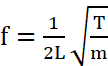

Now,
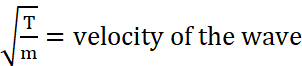

So,
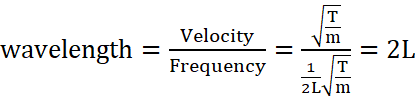

Wave number=K= (A)


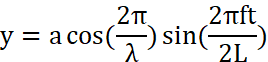
The wave equation,


We put the value of ,


We get the former equation.


More from this chapter

All 97 →
48

A uniform horizontal rod of length 40 cm and mass 12 kg is supported by two identical wires as shown in figure (15-E9). Where should a mass of 48 kg be placed on the rod so that the same tuning fork may excite the wire on left into its fundamental vibrations and that on right into its first overtone? Take g = 10 m s1.


49

Figure (15-E10) shows an aluminium wire of length 60 cm joined to the steel wire of length 80 cm and stretched between two fixed supports. The tension produced is 40 N. The cross-sectional area of the steel wire is 10 mm2 and that of the aluminium wire is 30 mm2. What could be the minimum frequency of a tuning fork which can produce standing waves in the system with joint as a node? The density of aluminium is 26 cm3 and that of steel is 7.8 g cm3.


51

A 2 m-long string fixed at both ends is set into vibrations in its first overtone. The wave speed on the string is 200 m s1 and amplitude is 05 cm. (A) Find the wavelength and the frequency. (B) Write the equation giving the displacement of different points as a function of time. Choose the X-axis along the string with the origin at one end and t = 0 at the instant when the point x = 50 cm has reached its maximum displacement.

52

The equation for the vibration of a string, fixed at both ends vibrating in its third harmonic, is given by

y = (04 cm) sin[(0.314 cm1)x] cos[(600π s1)t]


(A) What is the frequency of vibration? (B) What are the positions of the nodes? (C) What is the length of the string? (D) What is the wavelength and the speed of two travelling waves that can interface to give this vibration?