Q26 of 26 Page 1

(a) Illustrate the following reactions giving suitable examples in each case:

(i) Ammonolysis


(ii) Coupling reaction


(iii) Acetylation of amine


(b) Describe Hinsberg method for the identification of primary, secondary and tertiary amines. Also write the chemical equations of the reactions involved.


OR


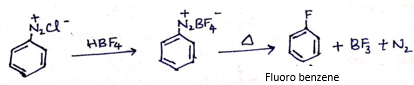
(a) Write the structure of main products when benzene diazonium chloride (C6H5Cl-) reacts with the following reagents:


i. HBF4


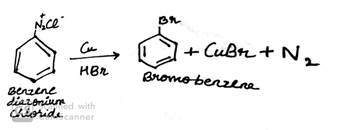
ii. Cu/HBr


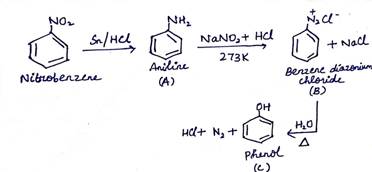
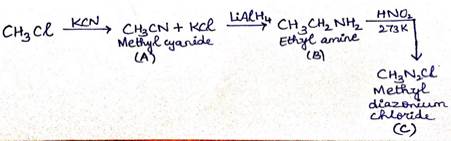
(b) Write the structure of A, B and C in the following reactions:


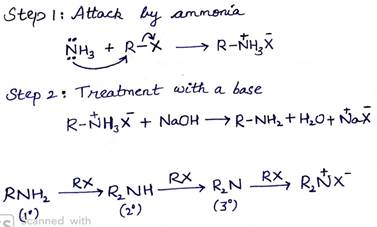
(a) (i) Ammonolysis


On treating alkyl or benzyl halide with ethanolic solution of ammonia, amines are obtained. This is a nucleophilic substitution reaction in which ammonia acts as the nucleophile. In this process there is a cleavage of C-X bond by ammonia which is named as ammonolysis.


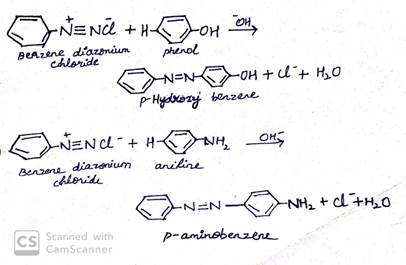
(ii) Coupling reaction


This is an electrophilic substitution reaction. When phenol reacts with benzene diazonium chloride, para position of phenol gets coupled with benzene diazonium ion to form an azo compound, p-azoxy azobenzene.


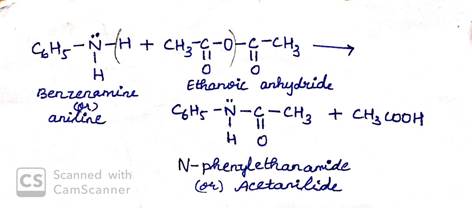
(iii) Acetylation of amine


Acetylation can be carried by treating acetic anhydride on amine.


(b) Hinsberg method for differentiating amines-


mide


Benzenesulphonyl chloride is known as the Hinsberg reagent.


Primary amines on reacting with the reagent forms N-ethylbenzenesulphonamide. (equation (1)). This compound has acidic proton so it is soluble in alkali.


Secondary amines on reacting with the Hinsberg reagent forms N,N-diethylbenzenesulphnamide. This compound doesn’t have any acidic proton so it is not soluble in alkali. [equation (2)].



Tertiary amines do not react with benzenesulphonyl chloride.


These difference in reactivity of amines towards the Hinsberg’s reagent can help differentiate between them.


OR


(a)


(i)


(ii)


(b) Write the structure of A, B and C in the following reactions:


(i)



(ii)



More from this chapter

All 26 →
22

An element X (molar mass = 60 g mol-1) has a density of 6.23 g cm-3. Identify the type of cubic unit cell, if the edge length of the unit cell is 4× 10⁻⁸ cm.

23

Seeing the growing cases of diabetes and depression among children, Mr. Chopra, the principal of one reputed school organized a seminar in which he invited parents and principals. They all resolved this issue by strictly banning the junk food in schools and by introducing healthy snacks and drinks like soup, lassi, milk, etc. in school canteens. They also decided to make compulsory half an hour physical activity for the students in the morning assembly daily. After six month, Mr. Chopra conducted the health survey in most of the schools and discovered a tremendous improvement in the health of students.

After reading the above passage, answer the following questions;


(i) What are the values (at least two) displayed by Mr. Chopra?


(ii) As a student, how can you spread awareness about this issue?


(iii) Why should antidepressant drugs not be taken without consulting a doctor?


(iv) Give two examples of artificial sweetners.


24

(a) Define the following terms:

(i) Activation energy


(ii) Rate constant


(b) A first order reaction takes 10 minutes for 25% decomposition. Calculate t1/2 for the reaction.


(Given: log2 = 0.3010, log3 = 0.4771, log4 = 0.6021)


OR


(a) For a chemical reaction R P, the variation in the concentration, ln[R] vs. time(s) plot is given as


(i) Predict the order of the reaction.


(ii) What is the slope of the curve?


(iii) Write the unit of rate constant for this reaction.


(b) Show that the time required for 99% completion is double of the time required for the completion of 90% reaction.


25

(a) Account for the following:

(i) Bond angle in N is higher than NH3.


(ii) H2S has lower boiing point than H2O.


(iii) Reducing character decreases from SO2 to TeO2.


(b) Draw the structures of the following:


(i) H4P2O7 (Pyrophosphoric acid)


(ii) XeF2


OR


(a) Draw the structures for the following:


(i) XeF4


(ii) H2S2O7


(b) Account for the following:


(i) Iron on reaction with HCl forms FeCl2 and not FeCl3.


(ii) HClO4 is a stronger acid than HClO.


(iii) BiH3 is the strongest reducing agent amongst all the hydrides of group 15.