
A particle of mass m is kept on the top of a smooth 8phere of radius R. It is given a sharp impulse which imparts it a horizontal speed u. (a) Find the normal force between the sphere and the particle just after the impulse. (b) What should be the minimum value of u for which the particle does not slip on the sphere? (c) Assuming the velocity u to be half the mininium calculated in part, (d) find the angle made by the radius through the particle with the vertical when it leaves the sphere.
i) The normal force between the sphere and the particle just after the impulse is 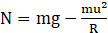
ii) Minimum value of u for which the particle does not slip on the sphere is 
iii) The angle made by the radius of the particle is 
Given
The radius of the sphere on which the particle is kept is R and the horizontal speed is taken as u.
Formula Used
Using the conservation of static and dynamic energy such as centripetal and potential energy, we have the conservation equation as
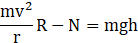
where
m is the mass of the object, v is the velocity, R is the radius of the circular path, r is the radius of the object, h is the height, N is the reactionary force of the block.
Explanation
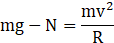
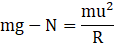
a) When a particle is kept on the top of the sphere a downward force of “mg” and an upward force of “N” is applied on the block giving the equation of forces as
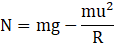
Therefore, the normal force of the particle is taken as
b) When a particle is at minimum velocity, the reactionary force becomes zero


c) let us take the velocity as half as written in the question
Hence the new velocity is

Now calculating the angle 
The velocity we use is u’ making the equation as
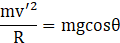
u’ is the velocity of the particle leaving the sphere


Placing the values of velocities as and
and 


Couldn't generate an explanation.
Generated by AI. May contain inaccuracies — always verify with your textbook.
