Q64 of 101 Page 132

A smooth sphere of radius R is made to translate in a straight line with a constant acceleration α. A particle kept on the top of the sphere is released from there at zero velocity with respect to the sphere. Find the speed of the particle with respect to the sphere as a function of the angle θ it slides.

The speed of the particle with respect to sphere is


Given


The radius of the smooth sphere is R, the constant acceleration is.


Formula Used


The formula for the total energy in terms of kinetic and potential energy is given as



where


The is the total energy in terms of kinetic and potential energy, m is the mass of the object, g is the acceleration in terms of gravity and l is the length of the object, is the angle of exit.


Explanation


As the sphere is moving at a constant acceleration with a pseudo force acting “” on the particle opposite to the downward force is .


Therefore, the speed of the particle is


The tangential force =



Placing the acceleration as


Integrating both sides we get
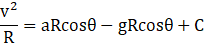


To know C, we apply boundary pressure of and for which we get:


Hence, the expression of velocity is


More from this chapter

All 101 →
60

A particle of mass m is kept on a fixed, smooth sphere of radius R at a position, where the radius through the particle makes an angle of 300 with the vertical. The particle is released from this position. (a) What is the force exerted by the sphere on the particle just after the release? (b) Find the distance travelled by the particle before it leaves contact with the sphere.

61

A particle of mass m is kept on the top of a smooth 8phere of radius R. It is given a sharp impulse which imparts it a horizontal speed u. (a) Find the normal force between the sphere and the particle just after the impulse. (b) What should be the minimum value of u for which the particle does not slip on the sphere? (c) Assuming the velocity u to be half the mininium calculated in part, (d) find the angle made by the radius through the particle with the vertical when it leaves the sphere.

62

Figure (8-E17) shows a smooth track which consists of a straight inclined part of length l joining smoothly with the circular part. A particle of mass m is projected up the incline from its bottom. (a) Find the minimum projection-speed u0 for which the particle reaches the top of the track. (b) Assuming that the projection-speed is 2u0 and that the block does not lose contact with the track before reaching its top, find the force acting on it when it reaches the top. (c) Assuming that the projection-speed is only slightly greater than u0, where will the block lose contact with the track?

63

A chain of length l and mass m lies on the surface of a smooth sphere of radius R >l with one end tied to the top of the sphere.

(a) Find the gravitational potential energy of the chain with reference level at the centre of the sphere. (b) Suppose the chain is released and slides down the sphere. Find the kinetic energy of the chain, when it has slid through an angle θ.


(c) Find the tangential acceleration of the chain when the chain starts sliding down.

