Q22 of 26 Page 1

Draw a schematic ray diagram of reflecting telescope showing how rays coming from a distant object are received at the eye-piece. Write its two important advantages over a refracting telescope.

The diagram for the schematics ray diagram of the reflecting telescope is
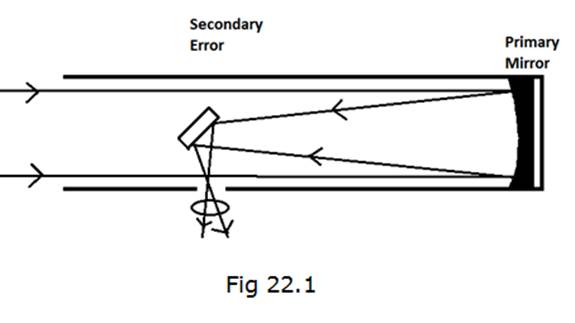


In the reflecting telescope, the image that is formed by the back reflection from a curved surface, is magnified or gigantified by the second mirror.


The advantages of reflecting telescope is


1. There is no deviation for the reflecting telescope as the objective is kept is a mirror.


2. Spherical deviation is lowered when it comes to reflecting telescope by using mirror objectives is a mode that shapes like a parabolic.


More from this chapter

All 26 →
20

a) Calculate the distance of an object of height h from a concave mirror of radius of curvature 20 cm, so as to obtain a real image of magnification 2. Find the location of image also.

b) Using mirror formula, explain why a convex mirror always produces a virtual image.


21

(i) State Bohr’s quantization condition for defining stationary orbits. How does de Broglie hypothesis explain the stationary orbits?


(ii) Find the relation between the three wavelengths λ1, λ2 and λ3 from the energy level diagram shown below.


23

Meeta’s father was driving her to the school. At the traffic signal she noticed that each traffic light was made of many tiny lights instead of a single bulb. When Meeta asked this question to her father, he explained the reason for this.

Answer the following questions based on above information:


(i) What were the values displayed by Meeta and her father?


(ii) What answer did Meeta’s father give?


(iii) What are the tiny lights in traffic signals called and how do these operate?


24

(i) An a.c. source of voltage V = V0 sin ωt is connected to a series combination of L, C and R. Use the phasor diagram to obtain expressions for impedance of the circuit and phase angle between voltage and current. Find the condition when current will be in phase with the voltage. What is the circuit in this condition called?

(ii) In a series LR circuit XL = R and power factor of the circuit is P1. When capacitor with capacitance C such that XL = XC is put in series, the power factor becomes P2. Calculate P1/P2.


OR


(i) Write the function of a transformer. State its principle of working with the help of a diagram. Mention various energy losses in this device.


(ii) The primary coil of an ideal step up transformer has 100 turns and transformation ratio is also 100. The input voltage and power are respectively 220 V and 1100 W. Calculate


(a) Number of turns in secondary


(b) Current in primary


(c) Voltage across secondary


(d) Current in secondary


(e) power in secondary