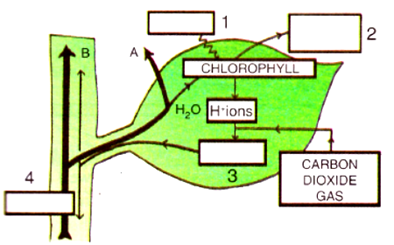
Photosynthesis in green plants is, directly and indirectly, dependent on so many plant structures. Explain briefly the role of the following structures in this process.
(a) Guard cells
(b) Cuticle
(c) Mesophyll cells
(d) Xylem tissue in the leaf veins
(e) Phloem tissue in Leaf Veins
(f) Stomata
(a) Guard cells: The guard cells aid the process of photosynthesis by regulating the opening and closing of the stomata in the leaves. This indirectly controls the movement of carbon dioxide through the stomata.
(b) Cuticle: The cuticle being transparent and waterproof, allows light to penetrate very easily.
(c) Mesophyll cells: Chloroplasts play a vital role in photosynthesis by trapping the light energy required for the process. These vital organelles are present in the mesophyll cells.
(d) Xylem tissue in the leaf veins: The xylem tissue controls the movement of water taken up by the root of the plant and directs it up to the leaves. Water is very essential for the process of photosynthesis.
(e) Phloem tissue in the leaf veins: The food prepared by photosynthesis is transported via the phloem tissue from the leaves, to the other parts of the plant.
(f) Stomata: The movement of carbon dioxide from the atmosphere into the cells is regulated by the stomata.
Couldn't generate an explanation.
Generated by AI. May contain inaccuracies — always verify with your textbook.