
Differentiate in two ways, using product rule and otherwise, the function
(1 + 2tan x)(5 + 4 cos x). Verify that the answers are the same.
Let, y = (1 + 2 tan x)(5 + 4 cos x)
⇒ y = 5 + 4 cos x + 10 tan x + 8 tan x cos x
⇒ y = 5 + 4 cos x + 10 tan x + 8 sin x {∵ tan x cos x = sin x}
Differentiating y w.r.t x –

Using algebra of derivatives, we have –

Use formula of derivative of above function to get the result.
⇒ 
∴  …equation 1
Derivative using product rule –
We have to find dy/dx
As we can observe that y is a product of two functions say u and v where,
u = (1 + 2tan x) and v = (5 + 4cos x)
∴ y = uv
As we know that to find the derivative of product of two function we apply product rule of differentiation.
By product rule, we have –
 …equation 2
As, u = (1 + 2tan x)
∴ 
⇒ 
⇒  …..equation 3 {∵
 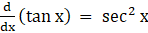 }
}
As, v = 5 + 4cos x
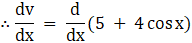
⇒ 
⇒  …equation 4 {∵
 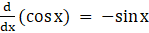 }
}
∴ from equation 2, we can find dy/dx
∴ 
using equation 3 & 4, we get –
⇒ 
⇒ 
∵ sin x = tan x cos x , so we get –
⇒ 
⇒ 
⇒  [∵ 1 – sin2 x = cos2 x ]
∴ 
Hence,
 ….equation 5
Clearly from equation 1 and 5 we observed that both equations gave identical results.
Hence, Results are verified
Couldn't generate an explanation.
Generated by AI. May contain inaccuracies — always verify with your textbook.