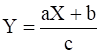
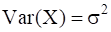
In a series of 20 observations, 10 observations are each equal t k, and each of the remaining halves is equal to –k. If the standard deviation of the observation is 2, then write the value of k.
Given, n=20, di=xi-a

Where 
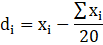


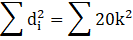


K=±2
AI is thinking…
Couldn't generate an explanation.
Generated by AI. May contain inaccuracies — always verify with your textbook.