Q30 of 79 Page 3

Four metal A, B, C and D are added to the following aqueous solutions one by one. The observations made are tabulated below:


Answer the following questions based on the above observations:


(a) Which is the most active metal and why?


(b) What would be observed if B is added to a solution of copper (II) sulphate and why?


(c) Arrange the metal A, B, C and D in order of increasing reactivity.


(d) The container of which metal can be used to store both zinc sulphate solution and silver nitrate solution?


(e) Which of the above solutions can be easily stored in a container made up of any of these metals?

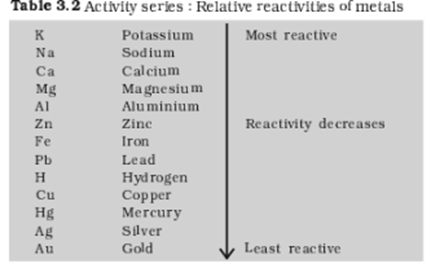
(a) The most reactive metal is metal B because it can react with iron and all the metals which come below in reactive series than iron. Hence in the table, it can react with all metal sulphates except zinc sulphate.

(b) A reddish brown deposit of copper will be formed as B will react with all other metal sulphates except zinc.


(c) B>A>C>D


reason: The more reactive metal sulphates with which it can react the more reactive it is.


(d) Container of metal D will be appropriate because it doesn’t react with any of the two.


(e) Zinc sulphate can be stored in any container made from these metals because it doesn’t react with any of them.

More from this chapter

All 79 →
28

Samples of four metals A, B, C and D were taken and added to the solutions given in the following table, one by one. The results obtained are as follows:


Metal


Iron (II) sulphate


Copper (II) sulphate


Zinc sulphate


Silver nitrate


A


No reaction


Displacement


B


Displacement


No reaction


C


No reaction


No reaction


No reaction


Displace


D


No reaction


No reaction


No reaction


No reaction

Use the above table to answer the following questions about metals A, B, C and D:


(i) Which is the most reactive metal?


(ii) What would you observe when metal B is added to a solution of copper (II) sulphate?


(iii) Arrange the metals A, B, C and D in the order of decreasing reactivity.

29

State reasons for the following observations:

(a) The shining surface of some metals becomes dull when exposed to air for a long time.


(b) Zinc fails to evolve hydrogen gas on reacting with dilute nitric acid.


(c) metal sulphides occur mainly in rocks but metal halides occur mostly in sea and lake waters.

31

(a) What is meant by corrosion? Name any two methods used for the prevention of corrosion.

(b) Suppose you have to extract metal M from its enriched sulphide ore. If M is in the middle of the reactivity series, write various steps used in extracting this metal.

32

The electronic configuration of a magnesium atom is 2, 8, 2 and that of a chlorine atom is 2, 8, 7. State the type of bond formed between the two and the formula of the compound formed. Show its formation with the help of electron-dot structure. Also list its two properties.