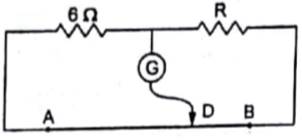
A 6-volt battery of negligible internal resistance is connected across a uniform wire AB of length 100 cm. The positive terminal of another battery of emf 4V and internal resistance 1Ω is joined to the point A as shown in figure. Take the potential at B to be zero.
(a) What are the potentials at the points A and C?
(b) At which point D of the wire AB, the potential is equal to the potential at C?
(c) If the points C and D are connected by a wire, what will be the current through it?
(d) If the 4V battery is replaced by 7.5 V battery, what would be the answers of parts (a) and (b)?

Concepts/Formula used:
Ohm’s Law:
Potential Difference (V) across a resistor of resistance R when current I passes through it is given by Ohm’s law:

Let the area of cross section of the wire (resistor) be A and resistivity be ρ.
Then,

(a)

As  ,
,

Let us account for the potential differences when moving from A to C.


(b)


Let the area of cross section of wire be A and resistivity be ρ.
Then,

where V is the voltage across a wire segment of length l.
As, all the quantities except for length are the same for all sections of wire AB,

Hence,



Hence, D is 66.67cm away from A.
(c) As  , there is no potential difference across CD and hence, the current through it is zero.
(d)
(a)

As  ,
,

Let us account for the potential differences when moving from A to C.


(b)


Let the area of cross section of wire be A and resistivity be ρ.
Then,

where V is the voltage across a wire segment of length l.
As, all the quantities except for length are the same for all sections of wire AB,

Hence,



This is not possible. As the length of the wire is only 100cm. There is no such point D.
Couldn't generate an explanation.
Generated by AI. May contain inaccuracies — always verify with your textbook.