
A particle of mass 100 g moving at an initial speed u collides with another particle of same mass kept initially at rest. If the total kinetic energy becomes 0.2 J after the collision, what could be the minimum and the maximum value of u.
Given: particle of mass m= 100g
Initial speed is u
Kinetic energy after collision is 0.2J
Then, Initial kinetic energy will be

Now,

Where  is the final speed of first block,
 is the final speed of second block.
v1+v2=u ----------- (1)
(v1 – v2) + L (a1-u2) =0
As u1= u and u2= 0
La1= (v2-v1) ------------ (2)
Adding equation (1) and (2)


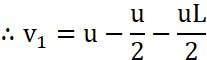

Total kinetic energy after collision =0.2J

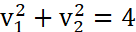
Putting values of v1 and v2
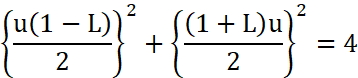
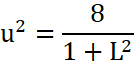
For maximum value of u denominator should be minimum
L=0
u2= 8
u = 2√2 m/s
For minimum value of u denominator should be maximum
L=1
u2=4
u = 2m/s
So, the minimum and the maximum value of u is 2 m/s and 2√2 m/s respectively.
Couldn't generate an explanation.
Generated by AI. May contain inaccuracies — always verify with your textbook.