
A small particle travelling with a velocity υ collides elastically with a spherical body of equal mass and of radius r initially kept at rest. The centre of this spherical body is located a distance ρ(< r) away from the direction of motion of the particle (figure
9-E23). Find the final velocities of the two particles.

[Hint: The force acts along the normal to the sphere through the contact. Treat the collision as one-dimensional for this direction. In the tangential direction no force acts and the velocities do not change].
It is given that the mass of both the bodies (small particle and spherical body) is same.
Let the velocity of the particle be v.
We break the particle velocity into two components v cos α
 (normal to the sphere) and
 v sin α
 (tangential to the sphere).

From figure,

 and
and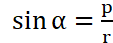
Here, the collision occurs due to the component v cos α.
After an elastic collision, bodies of same mass exchange their respective velocities.
Thus, the spherical body will have a velocity vcos α , while the particle will not have any component of velocity in this direction.
However, the tangential velocity of the particle will remain unaffected.
Thus, we have velocity of the sphere

And the velocity of the particle
Couldn't generate an explanation.
Generated by AI. May contain inaccuracies — always verify with your textbook.

