Q60 of 119 Page 159

A block of mass m is placed on triangular block of mass M, which in turn is placed on a horizontal surface as shown in figure (9-E21). Assuming frictionless surfaces find the velocity of the triangular block when the smaller block reaches the bottom end.


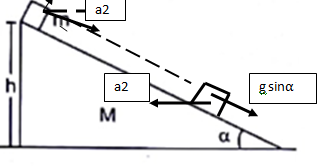
The block m will slide down the inclined plane of mass M with acceleration (relative to the inclined plane).


The horizontal component of a1 will befor which the block M will accelerate towards left.


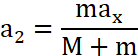
Let the acceleration be a2. According to the concept of centre of mass, (in the horizontal direction) external force is zero.

123.PNG


Thus,


_________ (1)


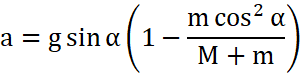
So, the absolute acceleration of m on the block M alone the direction of the incline will be


________ (2)


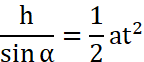
Let the time taken by the block m to reach the bottom end be ‘t’


Now,


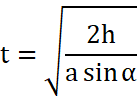
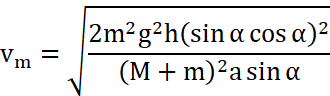
So, the velocity of the bigger block after time ‘t’ will be vm
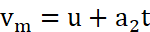


Now, putting the value of ‘a’ to the above equation


More from this chapter

All 119 →
58

The blocks shown in figure (9-E19) have equal masses. The surface of A is smooth but that of B has a friction coefficient of 0.10 with the floor. Block A is moving
at a speed of 10 m/s towards B which is kept at rest. Find the distance travelled by B if (a) the collision is perfectly elastic and (b) the collision is perfectly inelastic. Take g = 10 m/s2.


59

The friction coefficient between the horizontal surface and each of the blocks shown in figure (9-E20) is 0.20. The collision between the blocks is perfectly elastic. Find the separation between the two blocks when they come to rest.
Take g = 10 m/s2.


61

Figure (9-E22) shows a small body of mass m placed over a larger mass M whose surface is horizontal near the smaller mass and gradually curves to become vertical. The smaller mass is pushed on the longer one at a speed u and the system is left to itself. Assume that all the surfaces are frictionless. (a) Find the speed of the larger block when the smaller block is sliding on the vertical part. (b) Find the speed of the smaller mass when it breaks off the larger mass at height h. (c) Find the maximum height (from the ground) that the smaller mass ascends. (d) Show that the smaller mass will again land on the bigger one. Find the distance traversed by the bigger block during the time when the smaller block was in its flight under gravity.


62

A small block of super dense material has a mass of 3 × 1024 kg. It is situated at a height h (much smaller than the earth’s radius) from where it falls on the earth’s surface. Find its speed when its height from the earth’s surface has reduced to h/2. The mass of the earth is 6 × 1024 kg.