Q15 of 111 Page 252

The block of mass m1 shown in figure (12-E2) is fastened to the spring and the block of mass m2 is placed against it. (a) Find the compression of the spring in the equilibrium position. (b) The blocks are pushed a further distance (2/k) (m1 + m2) g sinθ against the spring and released. Find the position where the two blocks separate. (c) What is the common speed of blocks at the time of separation?


a) At equilibrium condition,



b) Given,



When the system is released, it will start to make SHM, where
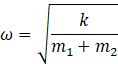


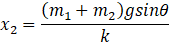
When the blocks lose contact, P=0, so



So the blocks will lose contact each other when the springs attain its natural length.


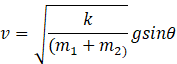
c) Let the common speed attained by both the blocks be v.



More from this chapter

All 111 →
13

A spring stores 5 J of energy when stretched by 25 cm. It is kept vertical with the lower end fixed. A block fastened to its other end is made to undergo small oscillations. If the block makes 5 oscillations each second, what is the mass of the block?

14

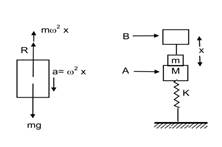
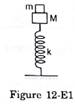
A small block of mass m is kept on a bigger block of mass M which is attached to a vertical spring of spring constant k as shown in the figure. The system oscillates vertically. (a) Find the resultant force on the smaller block when it is displaced through a distance x above its equilibrium position. (b) Find the normal force on the smaller block at this position. When is this force smallest in magnitude? (c) What can be the maximum amplitude with which the two blocks may oscillate together?


16

In figure (12-E3) k = 100 N m-1, M = 1 kg and F = 10 N. (a) Find the compression of the spring in the equilibrium position. (b) A sharp blow by some external agent imparts a speed of 2 m s-1 to the block towards left. Find the sum of the potential energy of the spring and the kinetic energy of the block at this instant. (c) Find the time period of the resulting simple harmonic motion. (d) Find the amplitude. (e) Write the potential energy of the spring when the block is at the left extreme. (f) Write the potential energy of the spring when the block is at the right extreme. The answers of (b), (e) and (f) are different. Explain why this does not violate the principle of conservation of energy.


17

Find the time period of the oscillation of mass m in figures 12.E4 a, b, c. What is the equivalent spring constant of the pair of springs in each case?