Q22 of 123 Page 412

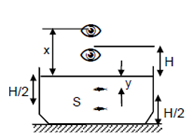
Consider the situation in figure (18-E7). The bottom of the pot is a reflecting plane mirror, S is a small fish and T is a human eye. Refractive index of water is μ.

(a) At what distance(s) from itself will the fish see the image(s) of the eye?


(b) At what distance(s) from itself will the eye see the image(s) of the fish?


22.PNG


Given, Refractive Index of water = μ


Height of the pot = H

Capture.PNG


(a)Let, x = distance of the image of the eye formed above the surface as seen by the fish


So,


Or,


Distance of the direct image =+


Similarly, distance of image through mirror =


=


(b)Let, y = distance of the image of fish below the surface as seen by eye.


So, y =


Direct image formed


Now, again another image of fish will be formed below the mirror. So, the real depth for that image of fish becomes


So, the apparent depth for the surface of water


Distance of image from the eye


More from this chapter

All 123 →
20

k transparent slabs are arranged one over another. The refractive indices of the slabs are μ1, μ2, μ3, … μk and the thickness are t1, t2, t3, … tk. An object is seen through this combination with nearly perpendicular light. Find the equivalent refractive index of the system which will allow the image to be formed at the same place.

21

A cylindrical vessel of diameter 12 cm contains 800π cm3 of water. A cylindrical glass piece of diameter 8.0 cm and height 8.0 cm is placed in the vessel. If the bottom of the vessel under the glass piece is seen by the paraxial rays (see figure 18-E6), locate its image. The index of refraction of glass is 1.50 and that of water is 1.33.


23

A small object is placed at the center of the bottom of a cylindrical vessel of radius 3 cm and height 4 cm filled completely with water. Consider the ray leaving the vessel through corner. Suppose this ray and the ray along the axis of the vessel is used to trace the image. Find the apparent depth and the ratio of real depth to apparent depth under the assumptions taken. Refractive index of water = 1.33.

24

A cylindrical vessel, whose diameter and height both are equal to 30 cm, is placed on a horizontal surface and a small particle P is placed in it at a distance of 5.0 cm from the center. An eye is placed at a position such that the edge of the bottom is just visible (see figure 18-E8). The particle P is in the plane of drawing. Up to what minimum height should water be poured in the vessel to make the particle P visible?
