Q76 of 123 Page 412

A gun of mass M fires a bullet of mass with a horizontal speed V. The gun is fitted with a concave mirror of focal length f facing towards the receding bullet. Find the speed of separation of the bullet and the image just after the gun was fired.

the focal length of the concave mirror = f

Mass of the gun= M


Horizontal speed of the bullet= V


Let the recoil speed of the gun= Vg
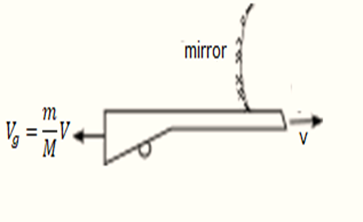


Using conservation of linear momentum,


At time t= t


The object distance from the mirror, u= -(Vt-t)


Focal length, f= -f


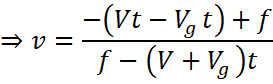
Image distance from the lens, v=?


By using mirror formula,


The separation between the image of bullet and the bullet at time t I given by
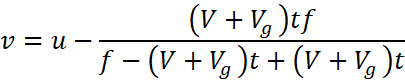


Differentiating the equation with respect to t, we get


Therefore, the speed of separation of the bullet and image just after the gun was fired is


More from this chapter

All 123 →
74

A particle is moving at a constant speed V from a large distance towards a concave mirror of radius R along its principal axis. Find the speed of the image formed by the mirror as a function of the distance x of the particle from the mirror.

75

A small block of mass m and a concave mirror of radius R fitted with a stand lie on a smooth horizontal table with a separation d between them. The mirror together with its stand has a mass m. The block is pushed at t=0 towards the mirror so that it starts moving towards the mirror at a constant speed V and collides with it. The collision is perfectly elastic. Find the velocity of the image (a) at a time t<d/V, (b) at a time t>d/V.

77

A mass m = 50 g is dropped on a vertical spring of spring constant 500 N m-1 from a height h = 10 cm as shown in figure (18-E14). The mass sticks to the spring and executes simple harmonic oscillations after that. A concave mirror of focal length 12 cm facing the mass is fixed with its principal axis coinciding with the line of motion of the mass, its pole being at a distance of 30 cm from the free end of the spring. Find the length in which the image of the mass oscillates.


78

Two concave mirrors of equal radii of curvature R are fixed on a stand facing opposite directions. The whole system has a mass m and is kept on a frictionless horizontal table (figure 18-E15).


Two blocks A and B, each of mass m, are placed on the two sides of the stand. At t = 0, the separation between A and the mirrors is 2R and also the separation between B and the mirrors is 2R. The block B moves towards the mirror at a speed v. All collisions which take place are elastic. Taking the original position of the mirrors-stand system to be x = 0 and X-axis along AB, find the position of the images of A and B at t =


(a)


(b)


(c)